
What you should know about omnichannel in e-commerce?
Omnichannel e-commerce is an omnichannel sales strategy in which all contact and sales channels are fully integrated, so the customer can freely move between different brand touchpoints, across digital and traditional channels – without losing the consistency of the shopping experience. Thanks to omnichannel, all data, preferences, and stages of each customer’s journey are individually monitored and recorded in the system.
Omnichannel is the basic terms of successful shopping: convenient, because hardly anyone does shopping using only one channel, closely following a defined shopping path.
Quite the opposite. Customers are increasingly mixing various sales and contact channels in their shopping journey. A customer might see a product ad on TV or its recommendations on social media, become interested, browse offers from various brands on their smartphone, add the product to their mobile app cart, then finalize the purchase on their computer and pick up the order in a physical store.
Another potential customer learns about an offering when reading comments on a product on Twitter, checks the price on a price comparison website, goes to an online store, and then makes a purchase at the point of sale, and then makes a purchase at POS.
Each customer follows his/her own purchasing process. The challenge is maintaining consistency in messaging, branding, and pricing across various sales channels and e-commerce platforms.
Technology in sales omnichannel strategy
The omnichannel strategy integrates many sales channels, ensuring consistency and uniformity of sales activities. All possible channels of reaching and customer service cooperate with each other, regardless of the place or form of purchase chosen by the customer. Advanced technology and the selection of appropriate IT tools are to provide the customer with the flexibility to choose the form of purchase, giving him a sense of comfort and building his loyalty.
Lack of integration between the digital and physical worlds, inconsistencies in products, prices or stock levels, or unsuccessful marketing campaigns can effectively discourage customers from making a purchase and reduce the value of their shopping cart. As a result, the business is less flexible and loses its competitive advantage.
The omnichannel strategy means meeting the needs and expectations of the customer in the form of tools that allow him to choose one or more options for the forms of purchase at the same time. Omnichannel is implemented by combining sales opportunities through a network of traditional stores, a network of online stores, marketing, customer service office and call center.
SAP offers a comprehensive Customer Experience ecosystem in which key roles are played by SAP Commerce Cloud, SAP Sales and Service Cloud, SAP Engagement Cloud (Emarsys), and the ERP system SAP S/4HANA — the operational backbone of the entire environment. When integrated with Sinch Contact Center, these solutions create a true omnichannel e-commerce ecosystem that enables:
Key features of an omnichannel strategy:
- Consistency of products, their prices, descriptions, and availability
- Synchronization and up-to-date customer data
- Ability to mix and match purchasing and communication channels
- Automation and personalization at scale
- The same high level of service anytime and anywhere
What are the key elements of an omnichannel commerce sales strategy?
- Easier research and good customer identification
Most shoppers say they always do research before they buy to ensure they’re making the best possible choice. That’s why it’s worth making it easier for them to find what they need. This convenience and consistency can help them with their research, increasing their likelihood of making a purchase and boosting your sales. And by integrating your marketing campaigns across various channels, you can effectively capture and engage potential customers at different stages of their buying journey.
From the perspective of the company it is very important to identify an Internet user browsing the product data sheet on his/her smartphone, a guest of a physical store viewing selected merchandise, as well as a person contacting the call center as the same person. It a false assumption that each of the above interactions has different participants and from beginning to end runs according to the business processes established by the creators of a given channel.
- Consistency of offerings and sales policies
Pricing, promotions, returns policies, warranties – everything should be identical across all sales channels, both online and offline.
- Real-time inventory management
E-commerce businesses need to have an eye on their inventory in real-time to ensure accurate stock levels and prevent overselling. Out-of-stock items online despite being available in-store can be a problem. Synchronization can be challenging when inventory data is spread across multiple systems or channels. In an omnichannel strategy, you’ll need to make sure your inventory data is centralized so you have real-time visibility into orders coming in from all sales channels.
- Integrated Payments
Thanks to integrated payment systems, customers can shop online and pay for their order in-store, or vice versa – see in-store and order via the mobile app. Customers can pay immediately, defer payment, or purchase in installments.
- Five-star customer service
An omnichannel strategy puts the customer first, so you need to ensure that customer service has access to detailed CRM customer cards, with purchase and interaction history, is available in every communication channel, and is supported by artificial intelligence that provides quick answers and assistance 24/7.
Customers expect seamless support across different channels, but disjointed systems and processes can result in fragmented customer experiences and delayed resolutions.
However, with an omnichannel strategy, you can implement automation tools that help you streamline workflows and improve efficiency in addressing customer inquiries across various channels and touchpoints.
- Integrated business systems
An integrated business systems environment is the foundation of an omnichannel strategy. A common CRM, ERP, and logistics system, along with unified customer management, customer history, returns, and complaints management, must be implemented in a single place—regardless of the purchasing channel. In the case of SAP systems, all this data is collected in one place. The strength of SAP business systems supporting the omnichannel strategy is the analyst. The SAP business systems provide advanced analyzes based on real data thanks to SAP HANA and SAP Analytics Cloud. Easy insight into activities carried out in various sales channels, allows you to make the right decisions, supported by predictive tools and artificial intelligence. The omnichannel strategy implemented with the use of SAP business systems means synergy and cooperation of online and offline sales tools, uniformity of rebate and loyalty programs, as well as coordination of inventory levels in a dispersed warehouse structure (also taking into account warehouses in traditional stores)
- Consistency of advertising materials and product characteristics across every channel
The consistent implementation of the omnichannel strategy means also providing a customer visiting a point of sale with reliable and consistent information on the product offering which he/she could see earlier in the e-shop or read in the printed brochure. Sometimes several separated departments (e.g. e-commerce and advertising) make the same descriptions of the same product, losing time and risking that their description – published in several places – will be inconsistent. In this case, the problem is to maintain the consistency of information about an offering with the current product base.
That is why systems like SAP, which enable easy management of multiple product catalogs, are gaining in value – the customer does not have to wonder whether the product which he saw in the newspaper advertisement is the same one that is viewed by him in the online store or POS.
Data integration acts as the catalyst for success in omnichannel commerce
Data integration forms the foundation of modern omnichannel retail because it synchronizes and centralizes critical business information across all touchpoints
- Integrated customer data ensures consistent customer experience
Traditional and digital purchases, returns and complaints, responses to marketing campaigns, data from conversations and contacts across all channels, providing invaluable insights into your customers’ behavior tastes, and preferences, including their interactions with product information. An omnichannel approach can optimize your gathering of data and keeps the conversation going – think of a customer reaching out on Instagram and ending up on your website browsing products. Then, they opt in for email marketing or text alerts. You can then send them an email with a discount code and a link to an item they viewed or added to their cart. This way, you can reach customers on their preferred channels and keep things in sync when they hop over to another channel to continue their journey.
- Integrated data is the most valuable resource in marketing and commerce
Integrated data allows you for a better understanding of your customers, more effective personalization of communications, and product and offer recommendations, more accurate customer segmentation, and tailored campaigns to their preferences. Good, up-to-date data helps forecast demand, upsell (upselling and cross-selling), and optimize inventory. Consistent data allows for better process automation and better business decision-making.
Comtrust – Your partner in omnichannel e-commerce
Omnichannel e-commerce is no longer just a trend — it has become a strategic direction for modern commerce. By integrating all sales channels, delivering a consistent customer experience, centralizing data, and automating business processes, companies can respond more effectively to market demands, increase sales performance, and build long-term customer relationships.
However, successful omnichannel implementation requires the right technological foundation and seamless integration of business, sales, and communication systems. Solutions from SAP and Sinch enable businesses to build a comprehensive digital ecosystem that supports real-time data synchronization, personalized customer engagement, and seamless customer service across every stage of the buying journey.
This article was developed based on expert materials provided by SAP and Sinch — global leaders in business and communication technologies. As a trusted partner of both organizations, Comtrust specializes in implementing and integrating advanced business and communication systems, delivering end-to-end omnichannel solutions that help companies scale modern e-commerce operations and gain a sustainable competitive advantage in the digital marketplace.
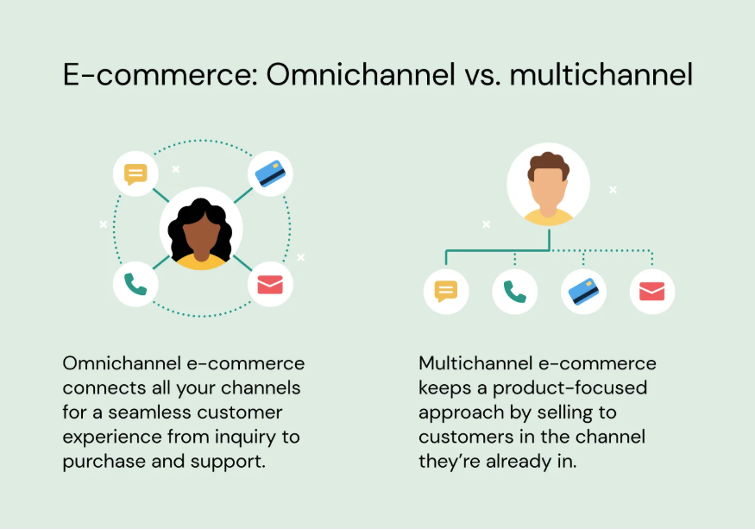
What is the difference between omnichannel e-commerce vs multichannel e-commerce?
| Omnichannel e-commerce | Multichannel e-commerce | |
| Definition | Integrates all channels for a unified shopping experience | Uses multiple channels so customers can shop, but they may operate independently without much integration |
| Customer Experience | Provides a unified, consistent experience across all channels | May differ across various channels |
| Goal | Enhance customer satisfaction and brand loyalty by providing a seamless customer experience | Expand reach and accessibility by offering products or services across multiple channels |
Source: Sinch
Author:
Joanna Pytlakowska
VP Sales & Marketing, Comtrust


Find out how customers use our products, services and SAP technology. Welcome to contact!


Products
SAP Customer Experience
SAP Field Service Management
SAP Conversational AI
SAP Intelligent Robotic Process Automation
Sinch Contact Pro
VoIP Infrastructure
1trust Service
Services
Implementations
Project management
Integration and Support
About us
Company and team
Partners and technologies
News