Call Center System
What is Call Center and Contact Center?
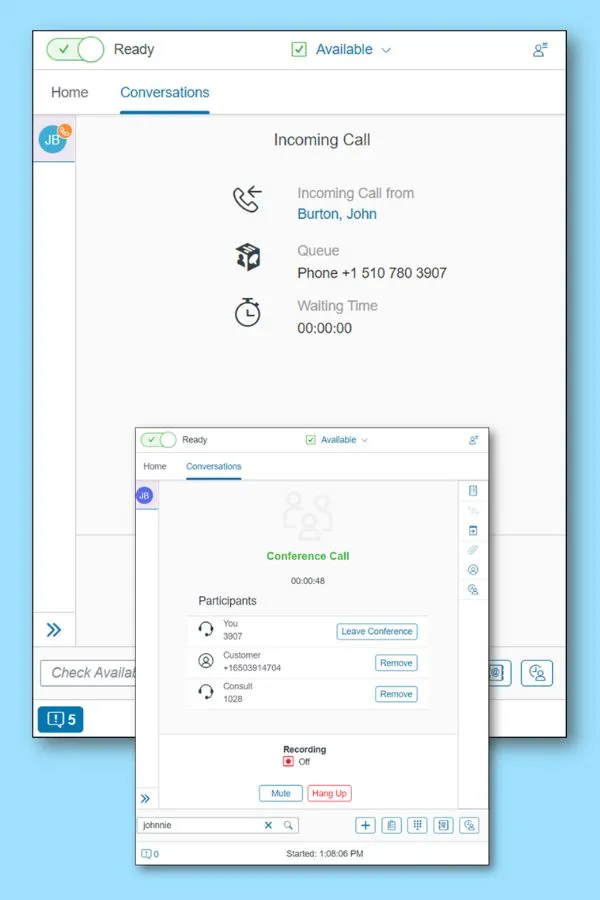
In the industry, the terms “call center” and “contact center” are sometimes used interchangeably, although they refer to different functional scopes. A call center solution is dedicated to the phone channel, while a contact center solution supports omnichannel communication (multiple communication channels).
Call Center systems in Business
Call centers are particularly effective when customers prefer to contact by phone. Customers call companies for a variety of reasons, often many people call at the same time. Without call center systems, only one customer could speak with the company at a time, while others would be unable to get through. Therefore, call center systems provide IVR and queuing, allowing customers to wait their turn. While waiting, various announcements can be played – from GDPR information to promotional messages.
Customer service, support, sales, and marketing employees are logged into the call center system. Some handle inquiries and requests on the hotline, ensuring customer satisfaction and retention. Others generate sales leads, support ordering processes, and participate in promotional campaigns. The same agents can simultaneously serve customers and sell, and their current focus depends on business goals, traffic volume, and seasonality.
Find out more about call center system implementation in the article:
Call Center System – What Is It and How Is It Used?
Blending in Call Center system
Types of Call Centers systems and organizations
Inbound
A hotline is the first line of contact between a company and its customers which means that agents must be well trained to provide accurate and helpful information, resolve problems efficiently, and ensure a positive customer experience.
Outbound
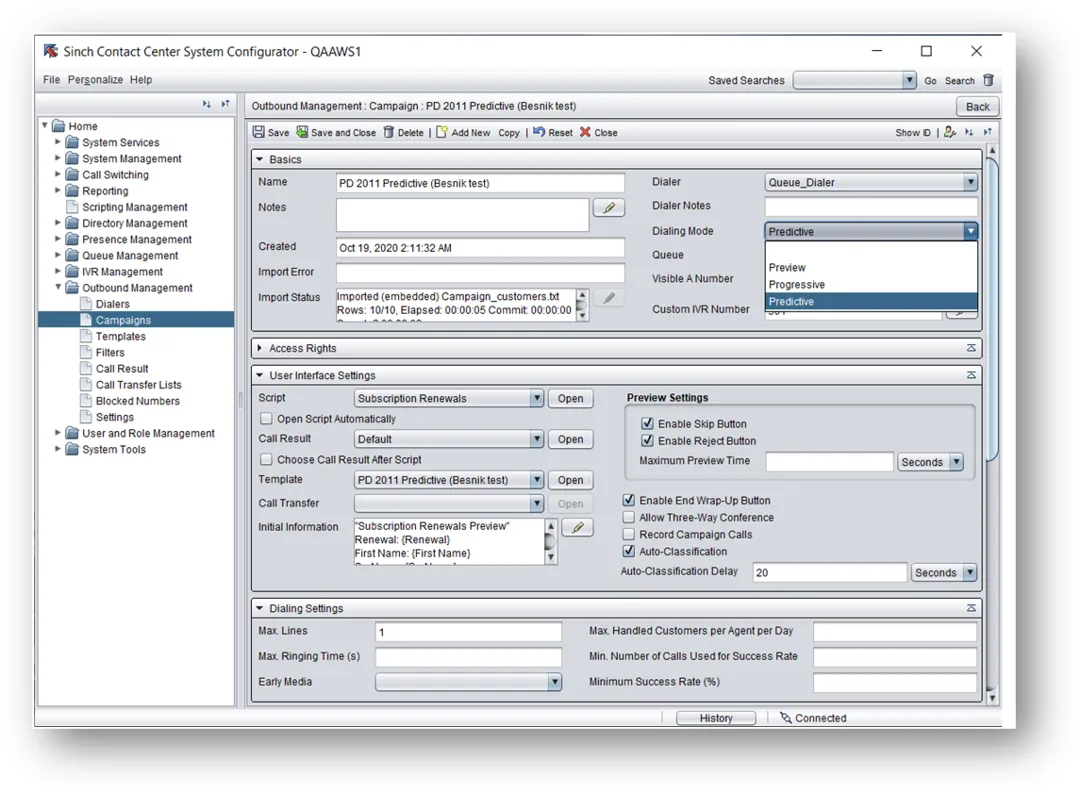
In outbound campaigns, agents actively call customers. A call center system can manage multiple outbound campaigns simultaneously. Each campaign has its own configuration, including specific customer data. Campaign details are imported into a database, and results can be exported, for example, to Excel.
There are several modes for handling outbound calls:
- Preview – Agents can review customers information before making a call and decide whether and when to contact them.
- Progressive – The system automatically dials the next call immediately after the previous one ends.
- Predictive dialing – The most advanced mode, in which the system automatically places multiple calls and predicts call timing and volume so that available agents can handle them efficiently.
Virtual Call Center
The first version of Sinch Contact Pro – originally called Wicom – was one of the world’s first virtual call/contact center solutions at the turn of the millennium. Remote work became significantly more widespread in 2020, and since then, virtual call centers have become the standard.
Modern call and contact center systems are IP-based, which means a virtual call center solution can be implemented regardless of the deployment model – whether cloud, on-premises, or hybrid.
When we hear Salesforce Call Center or SAP Call Center, for example, we immediately think of telephony infrastructure being integrated with Salesforce or SAP. We can imagine a team of consultants working on CRM software with headphones on.
Cloud Call Center vs on-premise Call Center
A cloud call center means the system is delivered as SaaS (Software as a Service) or CaaS (Communications as a Service). In this model, the company accesses the system via a subscription and pays based on usage. The term “on-demand” refers to the ability of cloud call center to dynamically adjust the number of users according to fluctuating traffic levels. For example, a customer service center may typically employ 100 agents, but during peak sales periods, staffing can increase to 200 seats, before returning to normal levels after a month or two.
In an on-premises call center (commonly referred to as on-prem), the company purchases licenses and installs the system on its own servers. After implementation, it usually pays for maintenance services from the provider, which include access to updates, upgrades, and patches.
A hybrid call center is a combination of both models, allowing organizations to use cloud and on-premises solutions simultaneously, depending on their needs.
Predictive Dialer in Call Center Systems
A predictive dialer is an automated outbound calling system that uses AI algorithms to dial multiple phone numbers simultaneously, predicting agent availability to maximize talk time. It filters out busy signals, voicemails, and disconnected numbers, connecting only live answers to agents.
Predictive dialers are ideal for high-volume campaigns, such as telemarketing, debt collection, and market research.
IVR, Skills Based Routing, Perffered Agent & Priority routing in Call Center systems

Modern call centers use process automation to increase workflow efficiency and deliver the best possible customer experience. Automated call routing through IVR makes it possible to identify customer needs based on criteria such as call topic, language, and location, and to connect callers with the most appropriate agents. Agents with different skill levels are assigned to specific queues, and calls are routed to the most suitable individuals based on their skills and expertise.
Preferred Agent Routing identifies callers (for example, by phone number) and directs them to their assigned account manager. In many cases, calls are also prioritized—VIP customers are given priority access to customer service.
Follow-the-sun is a specialized call routing strategy used in global customer service organizations, where agents are distributed across different time zones. Calls are routed to the location where it is currently daytime, ensuring continuous service availability.
Automation helps reduce wait times, minimize the risk of errors, and ensure that customers quickly receive the support they need, ultimately increasing customer satisfaction.
Call scripts – typical Call Center system tools
Well-designed scripts help accelerate the onboarding of new employees, ensure a consistent standard of service, and reduce stress in challenging situations.
Call Center Voicebot
The use of bots in call centers is currently one of the most important trends in business development. A voicebot is an excellent tool that, thanks to artificial intelligence, can independently conduct conversations with customers and provide answers to simple and repetitive questions, while complex cases that require empathy and an unconventional approach are redirected to employees.
Currently, the hybrid cooperation model is gaining popularity, which allows for greater automation and cost reduction. We create an environment where people and AI collaborate with each other.
Voicebots provide customer service, answer simple inquiries, and extract data from business systems. And not only that. AI voice assistants can support call center agents in their daily operations, prompt them during conversations, or gather information from customers to pass it on, for example, to specialized teams or for further analysis.
KPI – Key Performance Indicators in Call Center systems
Call center implementation can also improve internal process management, especially in companies that serve a large number of customers. To assess operational efficiency, organizations should track key metrics such as:
- First Contact Resolution / First Call Resolution (FCR)
- Average Handle Time (AHT)
- Abandon Rate / Call Abandonment Rate
- Average Speed of Answer (ASA)
Business Intelligence tools are used to link telecommunications events with other operational metrics and data. Equipped with advanced analytical tools, managers can identify patterns, uncover root causes, and predict future scenarios. As a result, they can improve operational efficiency and support business growth.
Call Recording and Service Quality Monitoring in Call Center systems
Call centers record calls and regularly monitor the quality of customer service to ensure that it meets both company standards and customer expectations. Quality specialists evaluate these recordings for compliance with guidelines, communication skills, and problem-solving effectiveness. This enables them to identify strengths and areas for improvement, helping the company tailor training programs and optimize service processes. Call recordings (and their transcripts) are also used for dispute resolution and for training AI-powered systems.
Companies often store call recordings in CRM systems, as attachments to the conversation in the customer’s record. Agents often claim to work in a Salesforce Call Center, SAP Call Center, or Microsoft Call Center, when in reality, they work in a CRM system integrated with the call center system (but it is invisible to the user)..
There are two types of monitoring in call centers:
Online monitoring (often displayed on large dashboards) shows everything currently happening in the call center. Real-time monitoring allows supervisors to adjust resources based on traffic and manage peak periods effectively.
Historical monitoring provides reporting and analytics based on past performance.
Monitoring delivers a wide range of data that supports the analysis of key customer service elements and metrics, such as call wait times, call duration, the number of transferred calls, and customer satisfaction levels. KPIs and reports form the basis for continuous analysis and optimization. Metrics also enable the evaluation of service effectiveness and problem-solving efficiency.
Post-call surveys further support performance monitoring by collecting customer feedback, helping evaluate agent performance, and setting development goals.
Sinch Contact Pro – main call center features
Blended inbound/outbound
Dowiedz się, jak klienci korzystają z naszych produktów i usług. Zapraszamy do kontaktu!

Produkty
SAP Customer Experience
SAP Field Service Management
SAP Conversational AI
SAP Intelligent Robotic Process Automation
Sinch Contact Pro
Infrastruktura VoIP
1trust Service
Usługi
Wdrożenia
Zarządzanie projektami
Integracje i pomoc techniczna
O nas
O firmie
Partnerzy i technologie
Aktualności
Polityka prywatności