
Omnichannel Sales the most important facts.
The primary objective of an omnichannel sales strategy should be to create a seamless customer experience across multiple channels, boosting sales and strengthening customer loyalty.
An omnichannel strategy focus on 360 customer view, analyzing each customer behavior, communication, and purchasing patterns. In this strategy, the brand also initiates contact with customers based on their preferences. Integrating multiple locations and data streams effectively simplifies sales process management.
When executed properly, integrating various sales channels and automating processes allow sales teams to work more efficiently and focus on high-priority tasks.
What Is Omnichannel Sales?
Omnichannel sales is a business strategy that integrates all sales and communication channels, allowing customers to interact with a brand through multiple touchpoints without interruption. The way people shop has changed dramatically over the last decade. Customers move seamlessly between physical stores, e-commerce platforms, and customer service channels before making a buying decision.
The modern customer journey often includes numerous interactions. A typical buying process might look like this, the customer
- sees an advertisement on social media or his mobile app
- visits the company’s website
- adds products to his shopping cart but leave without purchasing
- contacts the call center for additional information or get a call from telesales support agents
- visits a physical store to inspect the product
- completes the purchase online or over the phone
- Pick up the order at a local store or pickup point
- later contacts customer support for after-sales assistance
Each interaction influences the final buying decision. The more consistent and connected these touchpoints are, the greater the likelihood of customer satisfaction and long-term loyalty.
Omnichannel sales vs multichannel sales
Your customer may shop from one channel to another. However, multichanne sales doesn’t guarantee a consistent experience – offers, prices, and service may vary from channel to channel. This is where multichannel loses out to omnichannel. From the customer’s perspective, they are interacting with one company—not multiple disconnected systems. Customers Mix Purchase Channels More Than Ever. This flexibility has become the new standard. Businesses that fail to provide a seamless experience across channels risk losing customers to competitors that do.
Omnichannel takes it a step further by connecting these touchpoints through shared customer data. It seamlessly bridges digital and offline worlds, uniting direct communication and sales. An omnichannel approach seamlessly connects all channels, platforms, and devices, while a multichannel tends to use just one or two communication channels that aren’t necessarily interconnected.
Why Connect Physical Stores with E-commerce?
Integrating physical retail locations with online sales creates significant benefits for both customers and businesses. Some of the key advantages include:
- Shared inventory management across all channels
- Consistent pricing and promotional campaigns
- Buy online, pick up in-store options
- Easier returns and exchanges regardless of where the purchase was made
- A unified customer purchase history
- More personalized marketing and product recommendations
The Role of Call Centers in an Omnichannel Strategy
Despite the rapid growth of e-commerce many customers still prefer speaking with a representative when they need to:
- Confirm product availability
- Receive expert advice
- Place an order over the phone
- Clarify payment or delivery details
- Resolve post-purchase issues
In a true omnichannel environment, the customer service is an integrated part of the sales ecosystem, where customer service agents have access to the same information as online stores and retail staff, including customer history, order status, and inventory data.
How can Comtrust support your omnichannel sales strategy?
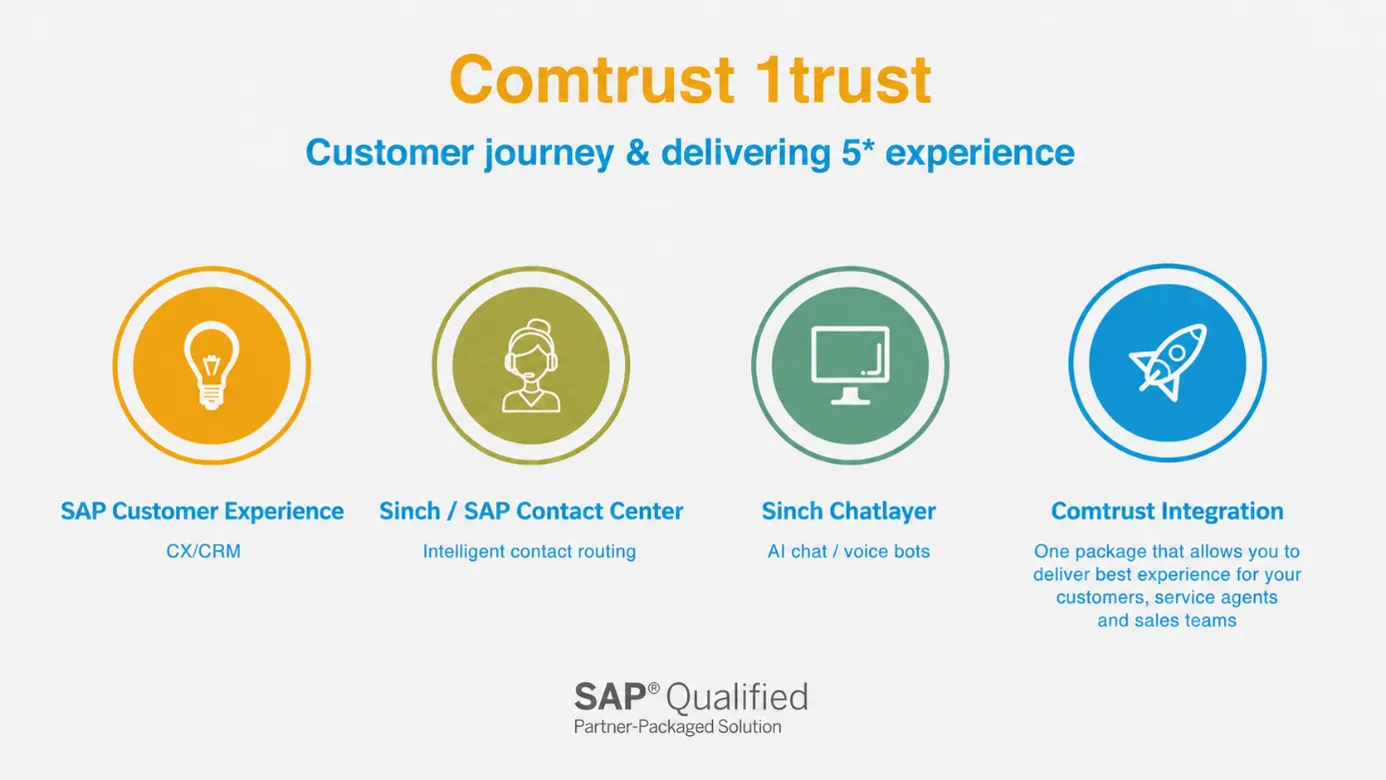
Comtrust is a trusted partner of SAP and Sinch, specializing in omnichannel CRM solutions and enables businesses to unify customer communications, streamline service and sales processes, and accelerate their digital transformation with scalable, intelligent omnichannel CRM solutions.
With Comtrust, you can build a truly omnichannel sales strategy powered by a 360-degree customer view. Connect every customer touchpoint and seamlessly enrich your CRM with valuable interaction data to gain a complete understanding of each customer journey. Engage customers proactively across every channel—from personalized marketing campaigns and online and offline sales to telemarketing, chatbots, voicebots, and customer service. Comtrust provides everything you need to deliver a consistent, connected, and personalized omnichannel experience that drives customer engagement, increases conversions, and builds long-term loyalty.
FAQ
What is Omnichannel Sales?
Omnichannel Sales is a strategy that integrates all sales and customer communication channels—including online stores, marketplaces, physical stores, social media, mobile apps, and customer support—into one seamless ecosystem. This allows customers to move effortlessly between channels without interrupting their shopping experience.
What is the difference between Omnichannel and Multichannel Sales?
In a multichannel model, each sales channel operates independently. Omnichannel, on the other hand, connects all channels into a unified system, providing shared product information, inventory levels, order management, and customer history.
What are the benefits of implementing Omnichannel Sales?
The key benefits of omnichannel sales aproach include:improved customer satisfaction, increased sales, better inventory management, faster order fulfilment, consistent customer experience across all sales channels.
Who can benefit from Omnichannel Sales?
Omnichannel solutions are suitable for businesses of all sizes—from small online retailers to medium-sized and large enterprises operating across multiple sales channels. They are particularly valuable for companies that combine e-commerce with physical retail locations.
Which sales channels can be integrated in an Omnichannel strategy?
The omnichannel sales model follows the customer in their purchasing decisions, so it most often combines: online stores, physical retail stores, marketplaces, social media platforms, mobile applications, B2B sales platforms and customer service and call centers.
What does the Omnichannel implementation process involve?
A typical implementation includes: analyzing current sales processes, selecting the appropriate technology integrating systems such as ERP, CRM,WMS, e-commerce platforms, and marketplaces, implementing workflows, and employee training, and then monitoring and improving operations.
Does implementing Omnichannel require replacing existing systems?
This is often the case, as IT systems have different databases and it’s not always possible to perfectly integrate technologies from different vendors, nor do they always support new purchasing channels. That’s why business often undertake digital transformation. However, it’s sometimes possible to integrate existing systems without completely replacing them, for example, by integrating existing infrastructure with an omnichannel contact center system.
How does Omnichannel improve customer experience?
Customers enjoy a consistent shopping experience regardless of the channel they choose. For example, they can start shopping on a mobile device, continue on a desktop, and collect their order from a physical store or pickup point. Your customer don’t need to repeat all his history when changes the channel.
Which business metrics can Omnichannel improve?
Businesses often see improvements in: conversion rate, average order value, customer loyalty, repeat purchase rate and order fulfillment efficiency.
How long does it take to implement an Omnichannel solution?
The implementation timeline depends on the number of sales channels, system integrations, and the complexity of business processes. Projects can take anywhere from a few weeks to several or even dosen months.
How do I get started with Omnichannel Sales?
The best place to start is by analyzing your current sales processes and defining your business goals. From there, you can plan system integrations and gradually connect additional sales channels to build a fully integrated Omnichannel ecosystem.
Why 1trust Comtrust is the best omnichannel approach?
1trust Comtrust is a ready to implement omnichannel CRM solution that combines purchasing and customer service processes with AI-powered omnichannel communication. Implementation time is short, and 1trust’s SAP Certified Partner Solutions guarantee successful implementation.
Author:
Joanna Pytlakowska
VP Sales & Marketing, Comtrust

Dowiedz się, jak klienci korzystają z naszych produktów i usług. Zapraszamy do kontaktu!


Produkty
SAP Customer Experience
SAP Field Service Management
SAP Conversational AI
SAP Intelligent Robotic Process Automation
Sinch Contact Pro
Infrastruktura VoIP
1trust Service
Usługi
Wdrożenia
Zarządzanie projektami
Integracje i pomoc techniczna
O nas
O firmie
Partnerzy i technologie
Aktualności