Voicebot and chatbot in recruitment processes – how to save time in HR?
Nearly every industry is grappling with a shortage of skilled workers. So, how can you quickly and effectively reach the best candidates and convince them to join your company? Using instant messaging, chatbots, and voicebots!
HR Chatbots and HR Voicebots Where Candidates Are – In Messaging Apps
If you wonder why you should include messaging apps and artificial intelligence into your recruitment and HR process, the answer is fairly simple: your candidates are already using them. Moreover, reach effectiveness across these channels is better than, for instance, via e-mail —with open rates around 90%, 90% of which occur within the first 15 minutes. In addition, messenger apps also allow you to integrate multimedia options and are ideal platforms for integrating automated solutions such as chatbots and voicebots.
The combination of new communication channels and artificial intelligence makes the recruitment process more engaging, efficient, and cost-effective for companies. This is especially evident in geographically dispersed organizations, where AI helps manage HR and understand employees across multiple locations and languages. Interestingly, AI bots in HR also improve and enrich employee experience through feedback and surveys that understand their intentions. Personalized, contextual communication can work wonders, motivating improved performance and problem-solving. The analytical dashboards themselves are a treasure trove of knowledge and allows you to make smarter decisions. Furthermore, HR bots like Chatlayer can automate up to 90% of tasks.
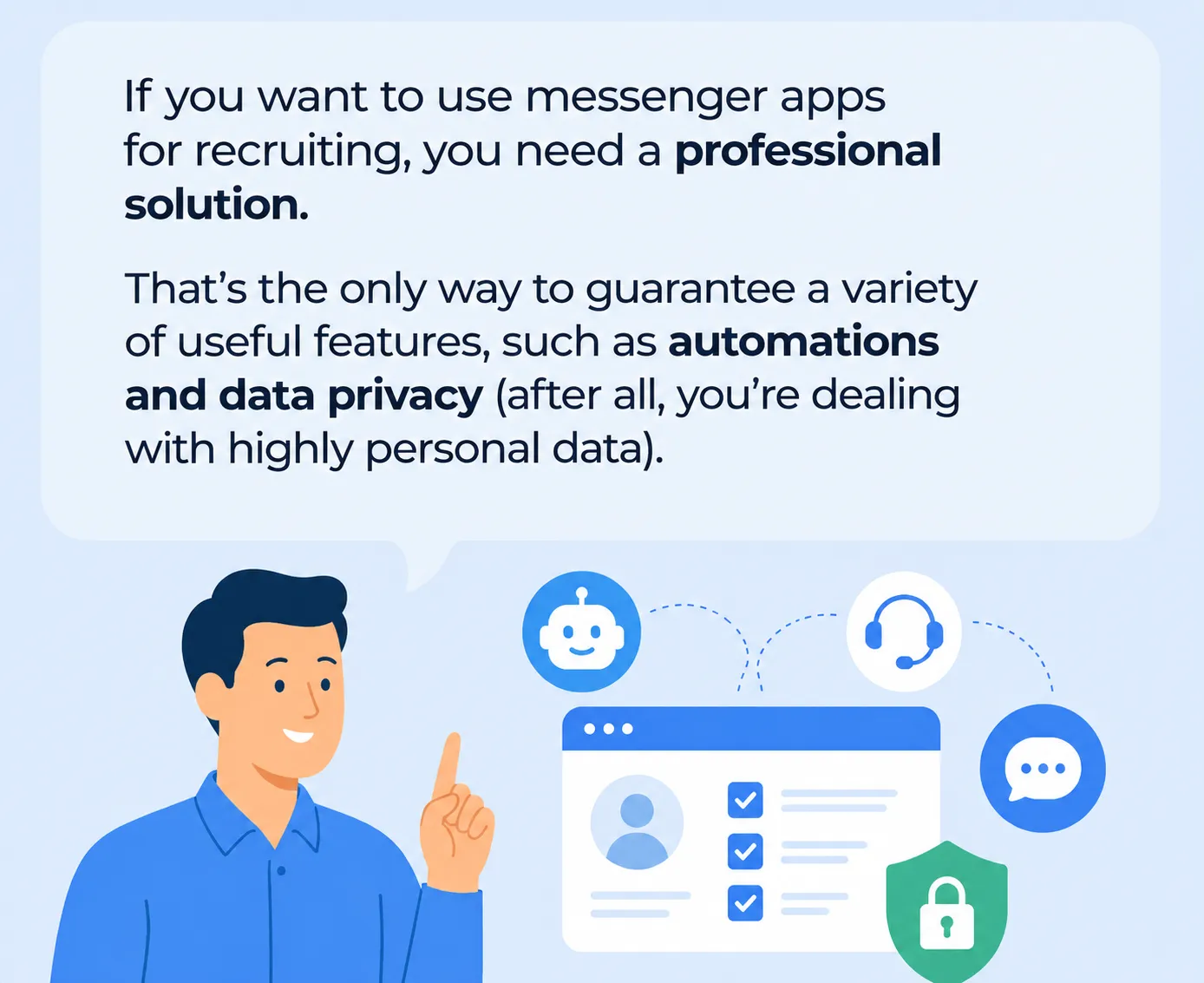
In which phases of the application process you can effectively use chatbots and voicebots?
Chatbots and voicebots at various stages of the recruitment process can prove to be a huge advantage. From informing interested talents about open job opportunities to sending a reminder for the interview appointment to onboarding new hires: using messenger apps in different stages of the recruitment process can be a huge advantage.
Stage 1: Recruitment Voicebot and Chatbot for Job Offer Communication
People that are interested in a new job are typically already searching for opportunities themselves. So, often, it’s a matter of finding the right people on the right place. Especially in combination with one-to-many notifications on messaging apps like WhatsApp, Telegram, or iMessage, it’s easy to let interested talents know that you’re offering a job. It’s also a lot cheaper than having to spend ad money.
Messaging apps offer conversational power that is well worth leveraging to engage candidates and gather insights into their expectations—for instance, by organizing a Q&A session on WhatsApp where candidates can ask the company CEO questions. You can also integrate playful elements, such as a job quiz to make recruiting more fun and engaging, and also reach more applicants faster.
Stage 2. Recruitment Voicebot and Chatbot for Candidate Sourcing
Once candidates know where and how they can contact your company easily, quickly and conveniently the next step is to get available jobs to them as quickly as possible. As mentioned before, the one-to-many message feature on messenger apps like WhatsApp, iMessage, or Facebook Messenger is an easy way to send out a position you want to fill to many people with just one single message.
You can also combine it with a chatbot. That way, when someone shows interest in your offer, your chatbot can ask clarifying questions or request their personal details. Situations arise where a candidate matches multiple job offers. For example, you can use chatbot workflow and only send one job ad at a time, but if someone isn’t satisfied with it, he can request another vacancy. This ensures candidates receive the most relevant job offers without being “spammed.” All data collected by the chatbot can then already be sent to a recruiter who, in a next step, can reach out to applicants in a more efficient and personalized way.
If your company has several HR departments or a more complex recruiting process a simple FAQ bot might not be enough for you. For instance, if HR departments receive a large number of questions every day or their agents have to call the candidates themselves and most of them are repetitive in nature, so with the help of AI chatbots or voicebots many process can be automated and make HR available for questions 24/7 or even they can actively conduct interviews with candidates.
HR voicebots are particularly useful in verifying whether a candidate’s application is current and maintains their interest in the job. Recruitment using a voicebot, especially this simple stage, is exactly the same as that conducted by an HR employee – but it takes significantly less time and does not involve any human resources. An HR voicebot, also known as a virtual HR specialist, calls candidates and conducts a short conversation asking questions according to a pre-prepared script. The responses are collected in a database, ready for reporting and further action. Voicebots can conduct interviews with hundreds of candidates simultaneously.
Stage 3. Recruitment Voicebot and Chatbot for Supporting Candidates During the Application Process
Once candidates find suitable job offers, the next stage of recruitment is the application process. If you support new recruits during the application process, you get better applications, save time on the back-and-forth if something is not submitted correctly, and you already show the recruits that you are interested in them, so it’ll motivate them even more to apply. Chatbots can use text, but also images and videos, making the process more engaging.
Moreover, with the new generation of employees, the need for quick, easy communication via mobile devices (rather than through an application form) is growing.
Messaging apps, such as WhatsApp, Facebook Messenger, Apple Messages allow you to do just that! Another advantage: applicants can submit their documents to the company using a channel they’re familiar with. Companies, in turn, have direct and personal contact with the applicant. The entire application process is faster and more effective for both sides.
It doesn’t end there. Applicants understandably want to know the current status of their application and you can automate this task through notifications to alert them whenever there is an update or remind them of an upcoming interview. You can enrich the notification with different file and media formats (PDF, images, videos, voice messages).
Stage 4. Voicebot and Chatbot for Employee Onboarding
You have found a great new person that you hired. Now, the next task is to onboard the new co-worker as quickly and as smoothly as possible. And, you’ve guessed it, messaging apps and chatbots are a great tool in this process as well! Whenever somebody starts out at a new company, there’s a lot of information coming at them at once. You can, of course, send all of that to them as PDF files or have them read a dozen website… or, you can make it really engaging by teaching them important information through a quiz on a messaging app and encourage him to use a chatbot linked to the FAQ and employee portal.
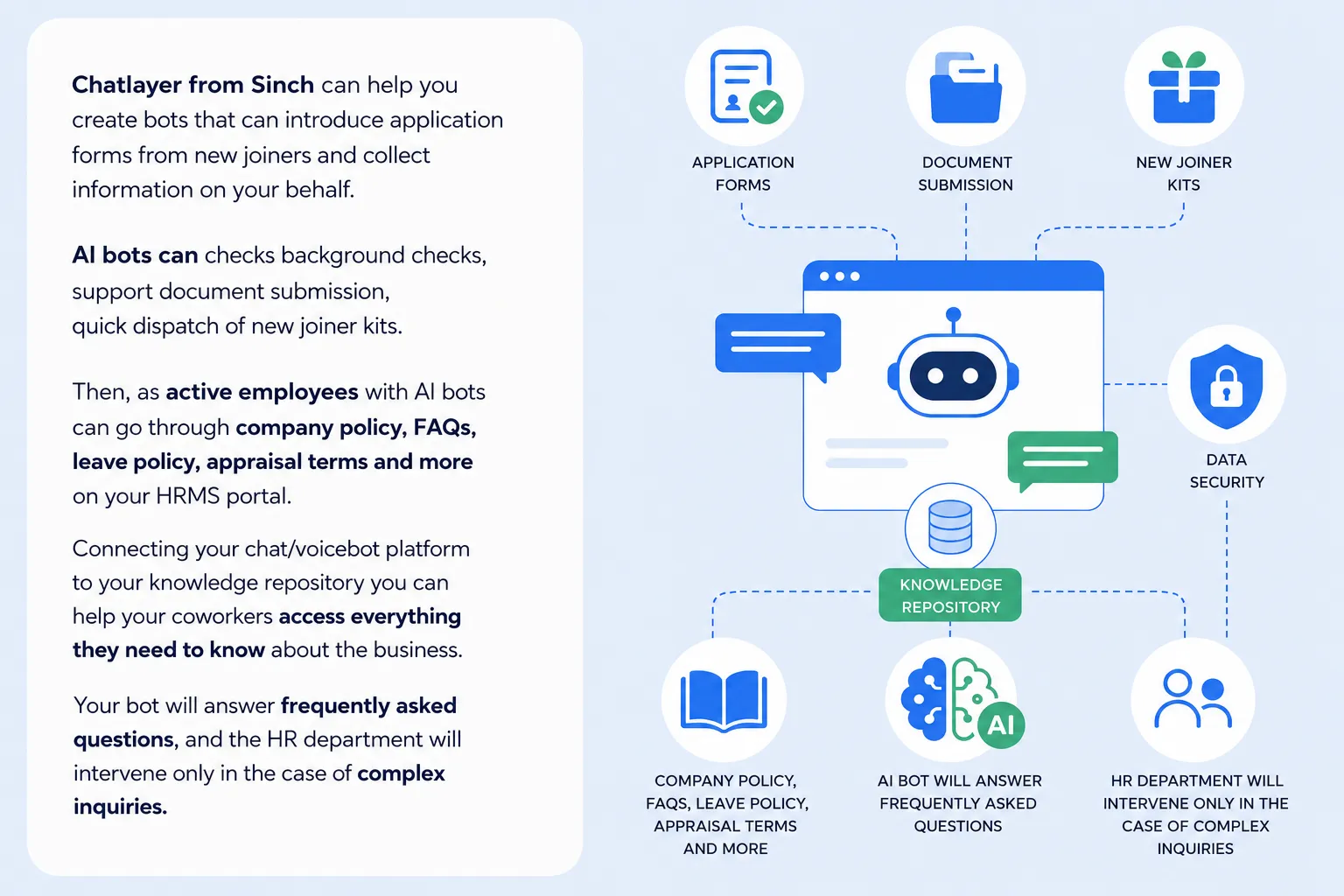
AI in HR – More Time for People, Less Time on Routine Tasks
Implementing HR chatbots and HR voicebots provides noticeable and tangible benefits, including employee time savings, lower costs, economies of scale, and redirecting HR team energy toward more complex matters that require creative thinking.
Choosing the right people is not the end of your task as human resource personnel. Added responsibilities include creating a holistic strategy for the welfare of each of the employees, often within a remote work ecosystem. How do you cater to hundreds of employees spread across geographies? Well, bringing AI is the forefront.
FAQ
How does a Voicebot work?
A Voicebot is an AI-powered virtual voice assistant that automatically conducts phone conversations with candidates, employees, and customers. During each conversation, it relies on three core technologies: Automatic Speech Recognition (ASR), Natural Language Processing (NLP/NLU), and Text-to-Speech (TTS). The entire processing process is performed in a few quick steps: listening and transcription (ASR – Automatic Speech Recognition), meaning the bot converts the caller’s spoken words into text. It incorporates elements and understanding (NLP – Natural Language Processing) so the bot analyzes the text to understand the caller’s intent, context, and key human information. Finally, the voicebot applies predefined business logic, conversation flows, and data from integrated systems or knowledge bases to determine the appropriate response. Thanks to
Text-to-Speech (TTS) it converts the generated response into natural-sounding speech, allowing the voicebot to reply in real time. Everything happens seamlessly, making the interaction feel like interacting with a human agent on a hotline.
What tasks can be automated with a Voicebot?
Voicebots are ideal for automating repetitive and time-consuming tasks, including answering frequently asked questions, providing information, sending appointment or deadline reminders, scheduling meetings, conducting simple surveys, and collecting information from candidates and employees.
What HR processes can a Voicebot support?
A voicebot can support a wide range of HR processes, including recruitment, onboarding, employee communication, interview scheduling, answering frequently asked questions, training reminders, leave and HR policy inquiries, and other routine HR tasks.
What is the difference between an HR Chatbot and an HR Voicebot?
An HR chatbot communicates with candidates and employees through text-based channels, such as websites, live chat, or messaging apps. An HR voicebot communicates through voice channels, including telephone calls and voice-enabled systems. Both solutions can be used with the same technology, such as Sinch Chatlayer, and automate contact with candidates and core HR processes.
How do HR Chatbots and HR Voicebots improve the recruitment process?
HR chatbots and HR voicebots can answer candidate questions, present job opportunities, assist with job applications, schedule interviews, send reminders, and provide updates throughout the recruitment process. By automating these repetitive tasks, recruiters can spend more time engaging with qualified candidates and making informed hiring decisions.
What are the benefits of using a Voicebot in HR?
Implementing a voicebot in HR offers numerous benefits, including: automation of repetitive HR tasks, faster response times for candidates and employees, 24/7 availability, multilingual communication, seamless integration with HR systems, improved scalability, reduced operational costs. AI gives more time for HR professionals to focus on strategic and people-centric activities.
Which companies can benefit from an HR Voicebot?
HR voicebots deliver value to organizations of all sizes. They are particularly beneficial for companies that manage high volumes of HR mogą poświęcić więcej czasu na zadania wymagające wiedzy, empatii i podejmowania decyzji.
Czy voicebot/chatbota można zintegrować z systemami HR?
Tak. Nowoczesne chat/voiceboty mogą integrować się z różnymi systemami HR, ATS, CRM, ERP oraz innymi narzędziami wykorzystywanymi w organizacji. Dzięki temu mogą korzystać z aktualnych danych i automatyzować wiele procesów.
Author:
Joanna Pytlakowska
VP Sales & Marketing, Comtrust
Recommended for you:



Dowiedz się, jak klienci korzystają z naszych produktów i usług. Zapraszamy do kontaktu!


Produkty
SAP Customer Experience
SAP Field Service Management
SAP Conversational AI
SAP Intelligent Robotic Process Automation
Sinch Contact Pro
Infrastruktura VoIP
1trust Service
Usługi
Wdrożenia
Zarządzanie projektami
Integracje i pomoc techniczna
O nas
O firmie
Partnerzy i technologie
Aktualności