
Omnichannel strategy how to start?
An omnichannel strategy is the complete integration of all sales and communication channels, as well as online and offline customer journeys, placing the customer at the center of business operations. Wherever and however customers interact with your business and brand, they receive a consistent service and offering. Implementing such a strategy increases customer satisfaction, improves sales results, and strengthens loyalty. How to get started? First, analyze your customers’ purchasing journey, integrate data from various channels, and then ensure consistent communication and processes. It’s also worth leveraging modern analytical tools and automation to more effectively manage customer relationships and continuously optimize operations. This allows your business to better meet consumer needs, respond more quickly to market changes, build a competitive advantage, and achieve long-term growth based on consistently positive customer experiences every day.
Comtrust specializes in implementing omnichannel digital transformation projects and in this article, you’ll discover what is a successful omnichannel strategy and learn how to launch it effectively.
What is an omnichannel strategy and what are its key elements?
An omnichannel strategy is an approach that integrates all sales and communication channels, providing customers with a consistent experience at every stage of their brand interaction.
Customer Journey Analysis in Omnichannel Strategy
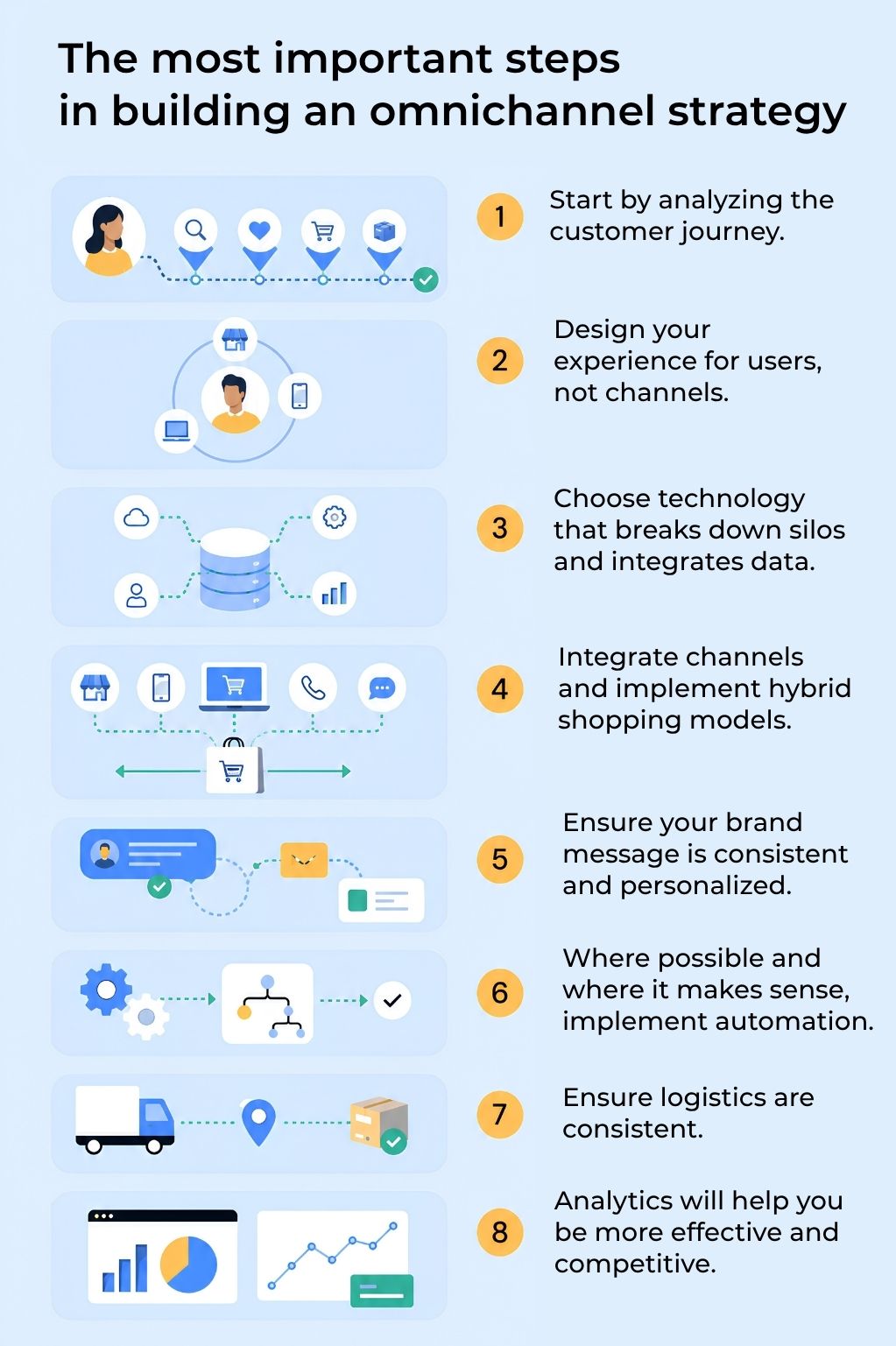
Establishing a successful omnichannel sales strategy begins with an analysis of who the customers are, what and when and where they buy, and which touchpoints the company currently offers. This analysis helps you to understand which channels customers prefer and how they wish to interact with the business. Customer journey mapping is particularly useful for evaluating customer groups and identifying ways a company can deliver the best sales experience at every touchpoint—and what might still be missing.
Find out and track how customers find your brand and how they move between channels through consideration, purchase, and beyond. Watch for pain points and chances to optimize at every step, like streamlining checkout across devices or simplifying support channels.
Focusing on this journey in detail helps you learn more about how your customers behave and what they like. This knowledge allows you to create a smooth experience that meets their needs, sale more and create more precise, personalized and high-converting marketing campaigns.
Design your omnichannel experience for users, not channels
Put your users front and center when designing your omnichannel strategy. Don’t fall into the trap of adding channels just because they’re trendy or your competitors are using them. Instead, concentrate on the platforms where your customers actually spend their time and prefer to interact with brands like yours.
Analyze your customer data from your CRM software. Which channels are driving the most engagement? Where are your customers reaching out for support? Use these insights to prioritize your efforts and resources. Create a cohesive experience that feels natural and convenient for your customers. This could mean a strong Instagram presence paired with live chat support, especially if targeting younger audiences. Or it could involve focusing on email and phone support for a B2B audience. Design an experience that feels personalized and valuable – not overwhelming.

Technology and consolidated data are the foundation of an omnichannel strategy
In an omnichannel strategy, a 360-degree customer view is key, so you should integrate your business systems (ERP/CRM) with contact center. Without it omnichannel is simply multichannel and becomes merely a collection of scattered, poorly functioning channels and touchpoints. In the SAP ecosystem, 360-degree customer view is based on consolidating data from various systems (sales, marketing, e-commerce, service) into a single unified profile in the SAP Customer Data Platform. With SAP omnichannel, each department (in-store, e-commerce, call center) sees the exact same, up-to-date customer data in real time. Customers don’t have to retell their story when they change contact channels. The system knows browsing history, previous purchases, and abandoned carts. This allows for perfectly tailored content and offers across each channel. Marketing and sales messages reach customers through their preferred channel and at the moment they are most likely to buy.
Channel integration and hybrid omnichannel purchasing models:
Integrating multiple sales channels, such as e-commerce, tele-sales, retail is essential to ensure that customers can move seamlessly between them. This is ensured by an omnichannel CRM, such as SAP Customer Experience integrated with contact center Sinch Contact Pro.
Instead of operating as independent silos (multi-channel), all touchpoints operate as a single, integrated ecosystem, where all data, such as customer data, inventory levels, and pricing are perfectly synchronized across every physical and digital touchpoint. And all contact data feeds your customer’s CRM cards. Omnichannel CRM provides companies with flexibility in order fulfillment and hybrid purchasing models, such as “Buy Online, Pick Up in Store” or “Buy in Store, Ship to Home”.
Consistent and Personalized messaging cross channels
Understanding your customers – their shopping journeys, preferences, and expectations – you can create a coherent brand message tailored to each customer group.
Your messaging should be recognizably “you” no matter where customers encounter it, but it also needs to flex and adapt to audience expectations and channels. Customers might prefer different types of content or respond better to certain tones. Use your customer centralised data to understand these preferences and tailor your messaging accordingly. Omnichannel technologies helps you experiment with different ways of expressing your brand across channels.
Consistency is not enough. Customers expect a personalized user experience and they’re willing to walk away if you don’t meet this expectation. According to Sinch Customer Connections report one in four customers might jump ship if you’re not hitting the mark with your messaging. So, how do you avoid this pitfall? Personalization is the answer. Use the data you have to create truly relevant, tailored content that resonate on a personal level. Consider their:
- Purchase history
- Browsing behavior
- Demographics
- Location
- Preferred communication channels
Automation tools help here. Use them to trigger personalized messages based on customer actions, like abandoned cart reminders or tailored product recommendations. When you nail this, you’re building lasting customer relationships that drive loyalty and growth.
Process Automation increases efficiency and reduces costs
Automation amplifies your omnichannel strategy. Why? Because automation not only accelerates campaign creation but most of all can provide quick, efficient service and sales 24/7. AI-powered tools generate content tailored to your brand voice and audience across multiple languages to save time and resources. Remember to choose technology that at the same time maintains a human touch. Always provide an option for customers to switch to a live agent if needed. This balance between automation and human interaction ensures efficient service delivery while addressing complex queries that require a personal touch.
Logistics in an Omnichannel Strategy
Logistics plays important role in an effective omnichannel strategy, connecting every stage of the supply chain—from inventory and warehouse management to order fulfillment, shipping, and returns processing. Its primary objective is to deliver a seamless and consistent customer experience, regardless of wherever purchases are made.
Achieving this level of integration requires real-time synchronization across warehouse, logistics, and sales systems. Enterprise platforms such as SAP enable this by managing all processes through a single, centralized database, ensuring data consistency and operational transparency across the organization.
Analytics supports your omnichannel management
Breaking down silos is key, not only simplifying processes but also making operations more efficient. Data transparency is a key factor and the foundation of proactive omnichannel management. The success of an omnichannel strategy must be continuously measured and analyzed to determine which channels are performing best and where improvements are needed. Furthermore, predictive analytics is more precise and allows for better planning and adapting resources to future events.
Business Benefits of Omnichannel
By thoroughly analyzing the customer journey, leveraging advanced technologies, and integrating all sales channels, you can offer your customers an unparalleled experience. Companies that successfully integrate their channels often experience measurable improvements in performance: increased sales revenue, higher average order value, improved customer retention. Moreover, companies are also more effective in marketing campaigns and customer service because they make better use of data and analytics.
FAQ
What is an omnichannel strategy?
An omnichannel strategy is a business approach that integrates all sales and communication channels to create a seamless customer experience. Whether customers shop online, use a mobile app, interact on social media, or visit a physical store, they receive consistent service and messaging across every touchpoint.
How do you get started with an omnichannel strategy?
The first step is to analyze your customer journey and identify every touchpoint where customers interact with your brand. You need to know your starting point, its strengths and weaknesses in the market and in the eyes of customers.
What are the benefits of an omnichannel strategy?
An omnichannel strategy improves customer satisfaction, increases loyalty, boosts conversion rates, and streamlines business operations. Companies that adopt this approach often see higher revenue, stronger customer retention, and a competitive advantage.
What is the difference between omnichannel and multichannel?
A multichannel strategy involves using multiple sales and communication channels that operate independently. An omnichannel strategy connects these channels, allowing customers to enjoy a consistent and seamless experience regardless of how they engage with your business.
What tools support an omnichannel strategy?
Common tools include Customer Relationship Management (CRM) systems, like SAP Customer Experience (SAP CX), sales and e-commerce platforms, marketing automation solutions, customer data platforms, and analytics tools and contact center solutions that help communicate with customers across all channels.
What are the most common mistakes when implementing an omnichannel strategy?
Common mistakes include failing to integrate customer data, delivering inconsistent messaging across channels, overlooking the customer journey, and introducing too many tools without a clear implementation plan or long-term strategy.
Why is incorporating an omnichannel marketing strategy into your overall strategy so important?
The goal of an omnichannel marketing strategy is to provide customers with a consistent experience and a unified message, regardless of whether they use social media, a website, a physical store, a mobile app, or email. An effective omnichannel marketing strategy personalizes communication and reaches customers the way they like the most at the time and place they prefer, while maintaining brand consistency.
Author:
Joanna Pytlakowska
VP Sales & Marketing, Comtrust

Dowiedz się, jak klienci korzystają z naszych produktów i usług. Zapraszamy do kontaktu!


Produkty
SAP Customer Experience
SAP Field Service Management
SAP Conversational AI
SAP Intelligent Robotic Process Automation
Sinch Contact Pro
Infrastruktura VoIP
1trust Service
Usługi
Wdrożenia
Zarządzanie projektami
Integracje i pomoc techniczna
O nas
O firmie
Partnerzy i technologie
Aktualności