
Omnichannel vs Multichannel —what’s the difference?
The terms omnichannel and multichannel involve engaging customers across multiple platforms, both in customer service and marketing. Despite being used interchangeably, not quite the same and there are a number of key differences between them:
- In a multichannel contact center, we offer customer service across multiple channels. While omnichannel means that customers can switch from one channel to another, for example, during chat conversation the customer switch to phone channel to make a call.
- In multichannel marketing, the same as in the contact center case, the term refers to multiple channels of communication between a brand and its audience. While, omnichannel is something else entirely: it is the interweaving of the virtual and real worlds.
This article explores the core differences and similarities between omnichannel and multichannel marketing strategies, detailing key touchpoints and their practical application. Crucially, we will treat the customer service contact center department as just one of those core channels.
Multichannel Marketing
Multichannel marketing involves engaging audiences through the use of multiple marketing channels, including email, web, mobile and social media. Multi-channel marketing is focused around each channel in isolation, without them being connected. Content is shared natively in-channel and often managed by siloed teams. As a result, customers who interact with a brand across different channels might receive a disjointed, inconsistent experience. For example, a customer might see an ad for a specific product on social media, buy it online, but then receive an email the next day promoting that same product.
Omnichannel Marketing
Omnichannel marketing focus less on individual channels and more on the overall customer journey. By connecting and integrating product, sales and customer data, as well as digital and physical channels, omnichannel offers a holistic approach that delivers a seamless customer experience — regardless of where they engage with a brand. This allows marketers to deliver exceptionally personalized omnichannel engagements, offering the right message to the right customer at the right time.
Crosschannel Marketing
Crosschannel marketing sits between multichannel and omnichannel marketing. It focuses on creating a coordinated and consistent experience for customers by connecting and integrating some, but not necessarily all, marketing channels.
In crosschannel marketing, marketers leverage data, insights, and technology to synchronize their messaging and campaigns across selected channels. For example, a customer who adds a product to their cart but leaves before making a purchase might receive an email including that product and other relevant recommendations.
Cross-channel marketing delivers a more connected experience than multichannel marketing. However, it falls short compared to omnichannel marketing, which takes cross-channel a step further by unifying data and enriching it with AI and predictive intelligence to deliver a seamless customer experience across all online and offline touchpoints.
Może Cię zainteresować:
Why Omnichannel Marketing Deserves Your Budget?
- Effective personalization
The modern shopper doesn’t just enjoy personalized experiences – they expect them. Omnichannel marketing helps you to deliver on those expectations and personalization goes beyond first names in subject lines. You can include more relevant messages, such as product recommendations, ads tailored to previous interactions, or push notifications related to user activity. By integrating your marketing channels and activating your product, sales and customer data, omnichannel marketing delivers 1:1 personalized, uniquely relevant shopping experiences across all channels that demonstrate a genuine understanding of your customers.
- Greater customer loyalty
A consistent experience builds brand trust. Customers are more likely to return if the brand “remembers” their preferences and contact history. Therefore, brands that want to maintain their leadership position must change their approach from new business to extracting value from their current customer base and keeping those first-time customers coming back for more. Research shows that even small successes in driving repeat purchases can have a dramatic impact on your bottom line. In fact, increasing customer retention rates by as little as 5% can boost profits by 25% to 95%. And when 31% of customers cite personalized, omnichannel experiences as the reason they repeat purchase and stay loyal to a brand, you can’t ignore this the opportunity. By creating seamless, 1:1 personalized experiences across multiple channels, you drive repeat purchases and grow customer loyalty.
- Improve Brand Recognition
On average, it takes seven touchpoints with a customer to drive a conversion. If you’re only engaging with your customers across two or three channels, you’re limiting your ability to get those all-important sales.
By building an omnichannel marketing strategy, you’re equipped to meet your customers with the right message, in the right channel, at the right time.
From in-store to email, by meeting your customers wherever they spend their time, you keep your brand front of mind and increase the chance of securing the sale the next time they’re in the market for your product.
- Increased sales and conversions
Companies with omnichannel approach get better sales results, recover abandoned carts more frequently, conduct remarketing more effectively, and better tailor their offerings to the customer’s purchasing stage. Omnichannel customers can conveniently continue the purchasing process wherever they find it most convenient.
- Better return on marketing budget and increase revenue
Omnichannel marketing’s focus on data, channel integration, personalization and automated workflows can have an impressive impact on revenue. By analyzing the entire customer journey, it is easier to assess which channels actually influence sales, instead of just looking at the “last click,” and this significantly helps optimize marketing costs, resulting in up to 30% marketing cost savings. Additionally, an interesting conclusion comes from the research conducted by Forrester on behalf of SAP Engagement Cloud showed Research by Forrester, commissioned by SAP Engagement Cloud, found that customer-obsessed brands with an omnichannel marketing strategy saw 62% increased sales of higher margin items compared to non-customer-obsessed brands.
The omnichannel approach gives two huge benefits – cost savings and revenue growth, which significantly impacts financial results and drive business outcomes.
- Better data and analytics
Omnichannel integrates data from various sources—CRM, advertising, online stores, apps, and social media. The data is reliable and consistent. This allows for more accurate analysis of customer behavior and better personalization of product offers and communications. Having everything in one place provides unified analytics that helps you accurately track and report on the performance of your campaigns. This not only helps you see which campaigns are moving the needle (and which need work), it also helps you to attribute sales to specific campaigns and channels, demonstrate the revenue impact of your activities, and make smarter marketing decisions moving forward.
Any brand that invests in an omnichannel strategy is perceived more favorably than other brands, and performs particularly well in:
- e-commerce
- retail
- services
- banking
- telecommunications
- beauty and fashion.
Omnichannel marketing is worth investing in because customers rarely use just one channel these days. In practice, omnichannel doesn’t mean “being everywhere,” but rather intelligently combining experiences into one cohesive path.
Source: Sinch
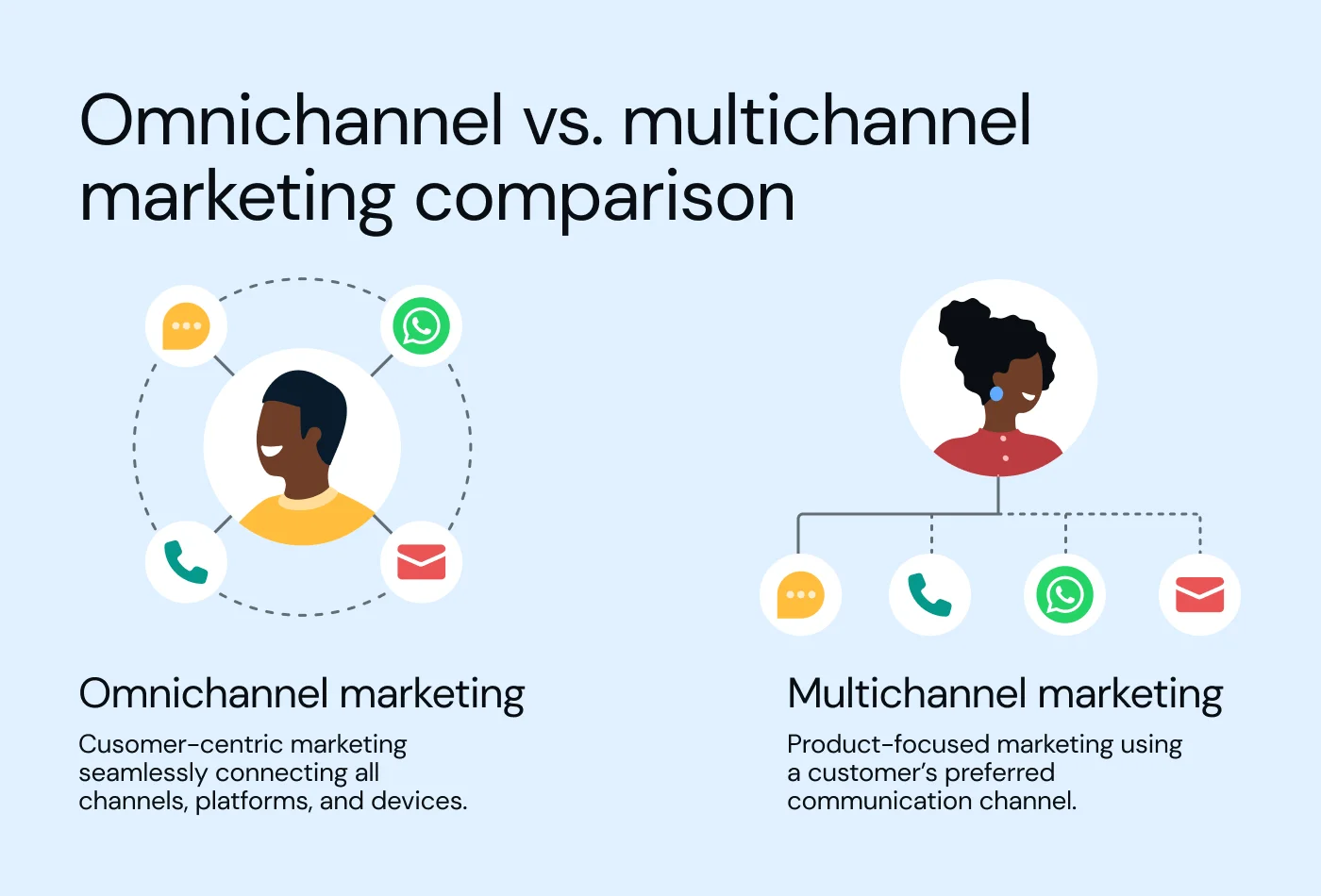
An omnichannel marketing approach seamlessly connects all channels, platforms, and devices, while a multichannel marketing channel tends to use just one or two communication channels that aren’t necessarily interconnected.
https://sinch.com/blog/what-is-omnichannel-marketing/
Which Channels are in an Omnichannel and Multichannel Marketing Strategy?
Before diving into individual channels, it is worth noting that while communication is inherently multichannel, omnichannel takes it a step further by connecting these touchpoints through shared customer data. Furthermore, a mature omnichannel strategy seamlessly bridges digital and offline worlds, uniting direct communication and sales. Let’s put it this way: an omnichannel marketing approach seamlessly connects all channels, platforms, and devices, while a multichannel marketing channel tends to use just one or two communication channels that aren’t necessarily interconnected. The most important channels are:
Digital Channels
Digital and mobile channels are the foundation of omnichannel marketing, enabling continuous, personalized, and measurable communication with customers throughout the various stages of their purchasing journey. They ensure a consistent customer experience with high levels of personalization and automation.
Email Marketing
Boasting one of the highest ROI potentials available from digital channels, email has earned its place at the center of many omnichannel strategies. By using email channel you can deliver 1:1 personalization at scale. This means that you can create email automations enriched with personalization tokens that tailor content based on past purchases, product affinity, browsing behavior and more. You can segment your customers precisely – seamlessly target your subscribers based on demographics properties or how they engage with you online, on mobile devices, and across other channels. Furthermore, leverage AI analytics you can drive repeat purchases.
Mobile Marketing
By using mobile as a channel, brands unlock the ability to directly engage their customer base in real-time through a variety of methods. The most popular is Mobile Inbox that keeps your messaging front of customers’ mind. Very popular are Mobile Push (highly targeted messages that appear on the screen or within the notification center of mobile devices) and In-App (allows you to capitalize on key customer lifecycle stages to deliver targeted product recommendations and offers). Using Mobile Wallet you reach mobile customers by delivering vouchers, coupons, tickets and more directly to Apple and Google Wallet that customers can redeem in-store at point of purchase). The last not the least: RCS (Rich Communication Services) a new modern mobile marketing tool, that allows you to send interactive messaging, product carousels, with purchase and interaction functions.
SMS Marketing
By using SMS as part of an omnichannel marketing strategy, you can connect with customers on and offline with personalized automations that for example increase newsletter signups, reduce cart abandonment, and increase conversions by sending tailored messages. SMS can also help you reach customers at risk of churn. Marketing automation tools provide you valuable data that prove the effectiveness of SMS campaigns and their impact on revenue.
Digital Advertising
Digital ads play an essential role not just in acquisition, but also in driving repeat conversions. By unlocking the power of CRM data, you’ll be able to enrich your omnichannel marketing strategy with personalized ad engagements across display, search and social.
Connected with the right omnichannel automation platform, digital ads will help you to
drive conversions with personalized engagements that reach the right customer with the right message at the right time. Additionally, you can create segments and build lookalike audiences that help you to reach new customers and refine your media spend and focus your budget on the areas that drive results. To increase the effectiveness of reaching customers, you can combine digital advertising with email, web, in-app, SMS and more.
Offline channels
Offline channels are physical touchpoints between a customer and a company, which can be leveraged for marketing and integrated into an omnichannel strategy. Key examples include
Direct Mail
By using an omnichannel automation platform to integrate your channels and unify your data, you can use direct mail to combine online and offline data to deliver 1:1 personalized experiences in the palm of the reader’s hand.
In-Store
Full integration of online and onsite world is currently the biggest challenge in retail. Integrating your physical retail locations with your omnichannel communication opens up a wealth of opportunities for customer engagement. By bringing in-store into your omnichannel mix, you can identify online customers in-store, helping you to attribute digital revenue and target them with cross-channel engagements and drive foot traffic with geo targeting and mobile push notifications. Additionally, you can bring online loyalty programs in-store to drive sales and grow program membership and then, create 1:1 personalized shopping experiences.
Events and Trades
Events and trade shows are an important element of an omnichannel strategy because they combine offline experiences with digital channels and allow you to build relationships with customers at multiple stages of the purchasing journey. Customers attending events transition from online to offline: they might see an event ad on social media, sign up via the website, receive an email reminder, then attend the trade show physically, and afterward, receive your sales offer or online remarketing. Customers can see the product in person, talk to experts, test the solution, and then continue the relationship digitally. This creates a cohesive customer journey across various channels.
Direct Communication and Sales Channels
Loyalty programs, customer service, post-purchase surveys and feedback, e-commerce and in-store sales, and all other direct-contacts and activities should be incorporated into omnichannel marketing, as customers often mix different channels in their purchasing journey. For example: a customer adds a product to their cart in an app, receives a reminder via email, picks up the product in a physical store, and then receives a personalized offer via text message.
Let’s mention contact center teams. By bringing your contact centers into your omnichannel marketing strategy, you’ll equip agents with the data they need to deliver personalized customer support experiences. drive sales by helping them resolve customer queries quickly. On the other hand, you contact center data is valuable for marketers, helping them to segment target groups and offer more personalized actions across multiple channels. Artificial intelligence, chatbots, and voicebots play a crucial role here. AI answers questions, supports customers throughout the purchasing journey, and increases retention.
Author:
Joanna Pytlakowska
VP Sales & Marketing, Comtrust
Find out how customers use our products, services and SAP technology. Welcome to contact!


Products
SAP Customer Experience
SAP Field Service Management
SAP Conversational AI
SAP Intelligent Robotic Process Automation
Sinch Contact Pro
VoIP Infrastructure
1trust Service
Services
Implementations
Project management
Integration and Support
About us
Company and team
Partners and technologies
News