What is a chatbot and how does it work?
A chatbot is a software application that communicates with people through text or voice. It can answer questions, assist customers, automate repetitive tasks, and support business processes around the clock. To do this, a chatbot first identifies the user’s intent, searches the company’s knowledge base and predefined conversation flows for the most relevant answer, and—if no suitable response is available—can generate one using artificial intelligence. Depending on how they operate, chatbots generally fall into three categories: rule-based chatbots, generative AI chatbots powered by large language models (LLMs), and hybrid chatbots that combine both approaches. Today, hybrid chatbots have become the enterprise standard.
In this article, we’ll explain how chatbots work step by step, explore the differences between chatbots, AI assistants, and AI agents, and outline the key factors to consider when choosing an enterprise chatbot platform. We’ll also use Chatlayer, implemented by Comtrust, as a practical example of a modern hybrid AI solution.
Key Information at a Glance
- A chatbot is software that simulates a conversation with a human through text or voice, using natural language processing (NLP) and artificial intelligence (AI).
- There are three main types of chatbots: rule-based chatbots, which provide predictable, fully controlled responses; generative AI chatbots, which understand context and create natural-language answers but may produce AI hallucinations; and hybrid chatbots, which combine both approaches. Hybrid solutions are now the preferred choice for enterprise deployments.
- A chatbot works in six stages: interpreting the user’s request, understanding intent and context (NLP and NLU), managing the conversation, generating the most appropriate response, learning from interactions, and continuously improving its performance based on feedback and analytics.
- A chatbot, an AI agent, and an AI assistant serve different purposes. A chatbot answers questions and automates conversations. An AI agent goes a step further by completing business tasks, such as creating support tickets or processing requests in enterprise systems. An AI assistant guides users through complex workflows, applications, and forms while providing contextual support.
- Successful enterprise chatbot implementations depend on three key factors: high-quality data, ongoing maintenance and optimisation, and robust security and compliance. This is why many organisations choose enterprise platforms such as Chatlayer, implemented by Comtrust, which supports more than 125 languages and integrates securely with business systems.
What is a chatbot?
A chatbot is software that simulates human conversation via text or voice, utilizing artificial intelligence (AI) and natural language processing (NLP) to understand and respond to user inputs.
Chatbots are widely used on websites, social media platforms (Chatbot Messenger), apps and smart devices and modern communication channels (WhatsApp Chatbot, RCS Chatbot) with aim to support visitors 24/7. A chatbot is more than just a tool for FAQs and document searches. It’s a platform for automating customer service processes.
Chatbots answer questions, provide customer service and automates simple tasks. They carry out tasks such as customer support, software navigation, and personal assistance, for example remembering shopping lists or sending alerts and reminders. Chatbots are also useful in internal process and operations like searching knowledge bases and documents.
Types of Chatbots
We most often divide chatbots into rule-based and AI-based chatbots. Implementing Comtrust combines both types of chatbots. We are going to share the best practise in this article.
What is a rule-based chatbot?
Rule-based chatbots communicate using a set of rules programmed by the bot’s designer. Scripting and conversational AI are used for design. Solutions like Chatlayer provide ready-made frameworks for building scripts and bot rules. These rules are generally based on recognising keywords in user inputs and matching them to a specific response, a method known as pattern matching. Matching doesn’t have to be 100% accurate to be good and relevant. For example, in online stores customers ask similar questions and most of them can be predicted. The difference may lie in the way the question is phrased and the choice of words. You can predict most ways of asking questions. However, queries that you can’t predict, or the chatbot cannot understand, or contextualize can be handled by generative AI
Pattern-matching chatbots are excellent for completing simple tasks, answering questions, and managing simple user-entered data. They are most commonly used for answering FAQs, logging service requests and complaints, and redirecting conversations (or calls) to customer service representatives. Their advantages include lower implementation and maintenance costs and greater control over the responses provided to customers.
What is an AI chatbot?
Modern AI chatbots such as ChatGPT are built on artificial intelligence technology that enables them to understand, process, and respond to human language in natural and meaningful ways. Generative AI powered chatbots use tools such as:
- machine learning (ML)
- natural language processing (NLP)
- large language models (LLM)
- deep learning
AI-powered chatbots are able to understand complex user inputs and generate unscripted and nonstandard, nuanced responses for a more advanced and fluid conversational experience. This also carries the risk of hallucinations. Their strength lies in understanding context and interpreting non-standard intent, making them ideal for personalization and user-specific questions. AI chatbots are used to build virtual assistants (AI agents), complete conversational scripts, mentoring and couching, and more.
Some AI chatbots can also continuously learn from past user interactions, optimising their language models to more accurately predict and respond to an increasingly wide range of inputs.
What is a hybrid chatbot?
A hybrid chatbot, such as the one delivered by Comtrust called Chatlayer, combines conversational AI (ConverAI) and generative AI (GenAI). Communicating with customers this intelligent hybrid bot answers questions based on predefined scenarios as the first step. You can use generative AI to create the questions and answers. Thanks to designed scenarios you can take control over responses. Only when the bot can’t find any answer for the user’s questions in the rules, it redirects the query to generative AI (GenAI will desperately try to find an answer, even at the risk of hallucinations). Chatbots like Chatlayer constantly learn from previous interactions, optimizing their language models and contextual understanding.
Chatbots vs. AI agents vs. copilots—what’s the difference?
Chatbot is an online technology that simulates human-like conversation. In simple terms, a chatbot simulates a natural conversation, answers questions, and provides recommendations. An AI assistant or virtual agent is more than just a bot answering online questions. Chatbots generally communicate through text, such as via messaging or e-mail. AI agents, virtual agents or virtual assistants, do not have this limitation. AI agents perform tasks, while AI assistants help navigate complex IT systems and complicated forms, suggesting which tasks to perform, where, and how. AI agents can provide interactive, conversational voice responses as well as text responses. They are commonly used in call centres, customer service, support, technical assistance, and even sales and marketing. Chatlayer fulfils both AI business functions, and even more.
Integration API is a key differentiator for AI agents and AI assistants in comparison to basic chatbot technology. Chatlayer offers integration tools and APIs with business systems, allowing the virtual assistant to perform tasks within the systems on behalf on a user which can mean anything from writing e-mails and creating images to analysing data and generating reports, filing tickets or complains.
How do chatbots work?
How a chatbot works varies greatly depending on the type of bot. The best way to demonstrate how it works is Chatlayer, enterprise technology. This world-leading chatbot technology combines both generative AI and conversational AI and offers API for integration with business and communication systems, allowing Chatlayer to function as an AI agent and an AI assistant.
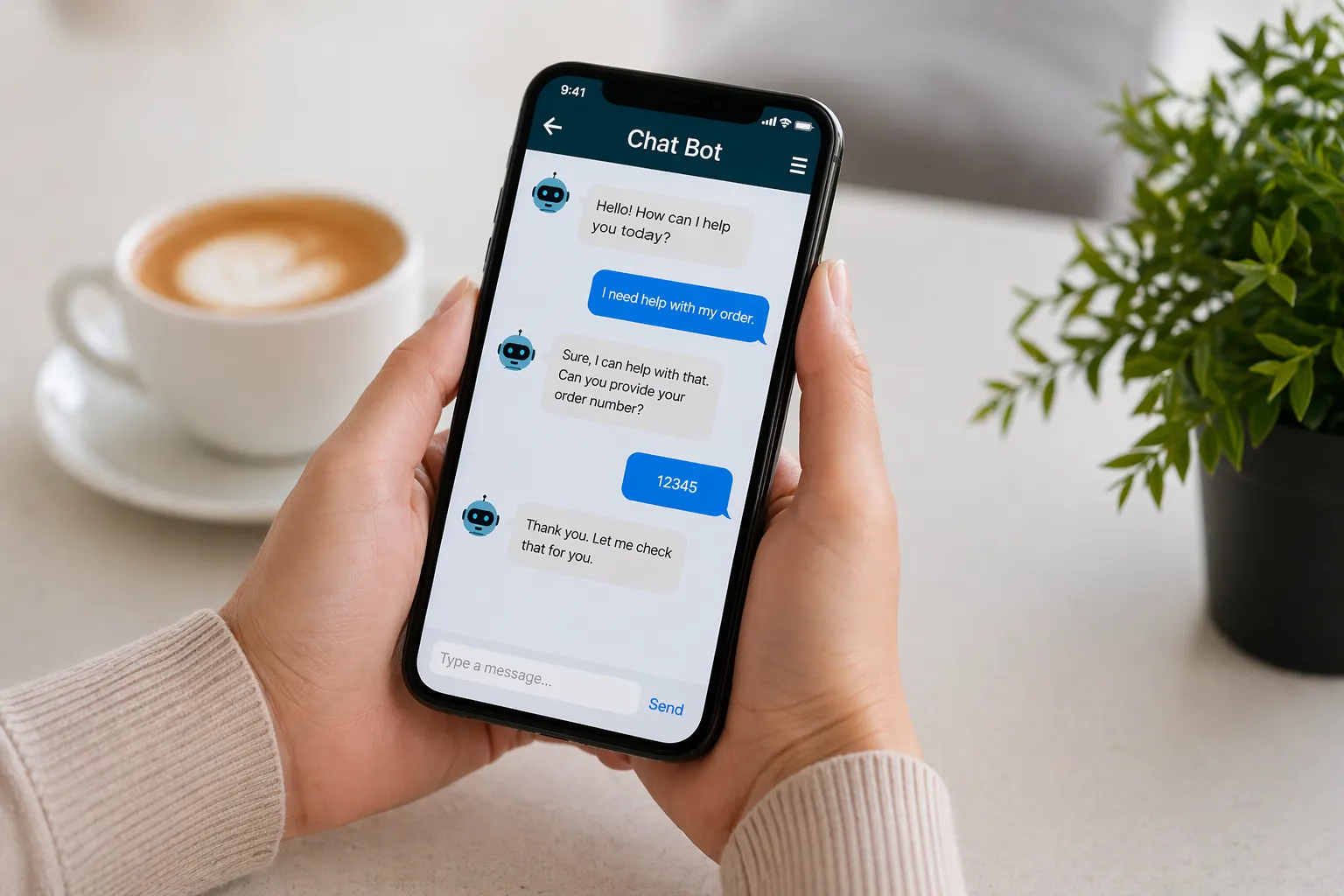
Customer and user queries are initially directed to the rule-based component of the chatbot, which operates using conversational AI and a predefined set of responses or actions.
For example, when using a customer service chat platform, a customer might type: “I want to return my item.” The bot analyses the input for recognized keywords—in this case, “return” and “item.” It then matches these keywords with predefined rules and database entries to trigger an appropriate response. For instance, it may ask for clarification about the specific item being returned or provide instructions based on the product type.
However, situations may arise where the item is unusual or rarely purchased, and the scenario was not anticipated during the chatbot’s design. In such cases, the bot may lack the necessary information in its database. The query is then forwarded to the generative AI component of the chatbot, which interprets the user’s intent and generates the most relevant response. For example, it may determine that the customer has mistaken the store and that the company does not carry the product in question.
As a final step, if generative AI cannot provide a satisfactory answer, the chatbot may ask the user to rephrase the question or escalate the interaction to a human agent.
Let’s look at the process how an online chatbot works from the perspective of properly recognizing intent and generating responses. Thera are key individual stages of this process:
- Input interpretation: First, the bot’s AI interprets the user’s input in text or speech form, converting speech inputs into text with speech recognition technology.
- Context understanding: The AI uses NLP to break down and analyse the text and then NLU to understand the context and intent behind it. Deep learning helps the AI to interpret the input’s potential nuances, ambiguities, and contextual word usage.
- Dialogue management: This determines the flow of the conversation based on intent, context, and system capability. It guides the interaction when querying databases or carrying out actions as needed for more accurate and relevant responses.
- Response generation: The AI then provides the most appropriate response to the user’s question, either by selecting an answer from a set of predefined options or by using ML to generate a new response on the spot.
- Continuous learning and adaptation: Through ML, the AI system powering the chatbot continually improves, learning from each conversation as it enhances its ability to predict and respond to diverse requests.
- Feedback loop: Incorporating user feedback into the system enables it to recalibrate its conversational models and further refine its performance and accuracy in future interactions.
What are the benefits of a chatbot?
AI chatbot’s ability to process natural human language inputs and provide personalised, autonomous services can offer significant benefits to consumers and businesses.

The benefits of chatbots for customers
- Customers seek customer support for questions, complaints, or urgent issues often our of working hours and do not wish to wait hours or even days for a response. Chatbots working 24/7 can handle high volumes of simultaneous interactions, reducing waiting times with instant responses.
- By combining multilingual capabilities with 24/7 global support coverage, chatbots can help users obtain information or services they need at anytime and anywhere. Chatlayer supports over 125 languages, so one universal bot framework can support customers worldwide.
- The enterprise chatbot delivered by Comtrust is designed for omnichannel deployment, allowing it to be deployed across a company’s website, social media, and messaging apps such as WhatsApp, RCS or as a voicebot on phone channels. The communication channel can be tailored to the customer’s preferences and needs.
- AI chatbots can analyse user data and preferences to deliver personalised services that could include anything from recommendations to tailored offers based on previous interactions and purchases.
The benefits of chatbots for business
- Businesses can use chatbots to streamline their operations by automating workflow approvals, leave requests, and other internal processes like human resources management, leave management, new employee onboarding.
- By delegating the most common customer service questions or issues to AI agents, human agents can assist customers with complex issues that require greater time commitments.
- Chatbots can help increase conversion rates by answering questions about a product or service and guiding the customer towards making a purchase, recommending additional products (e.g. purchasing a laptop bag).
- Having chatbots manage customer interactions around the clock removes the need for expensive out-of-hours staffing.
Learn more: Enterprise chatbot
Other noteworthy use cases include:
Utilities: receiving failure reports, entering meter readings.
Healthcare: Assisting patients in finding healthcare providers, booking examinations, reminding them to take their medicine on time, and notifying them of upcoming appointments.
Education: Supporting students both inside the classroom with personalised tutoring and study aids, and outside it through enrolment assistance with information on course availability and requirements.
Banking: Assisting users in tracking their expenses, setting up automated payments, and offering intelligent financial advice based on a user’s spending patterns, transaction history, and financial goals.
Manufacturing: Automating supply chain processes and maintenance scheduling, coordination of production and data exchange between the company’s factories, monitoring equipment, and interfacing with other IoT industrial devices.
HR: Guiding new employees through processes such as benefits enrolment, providing instant responses with information on payroll details or company policies, and even recommending personalised training courses.
Government: Assisting users in applying for social benefits and services, registering to vote, and accessing information on public programmes, licences, permits, and regulations.
E-commerce: Providing personalised customer recommendations, streamlining purchasing processes, and re-engaging customers with abandoned baskets.
Marketing and Sales: Generating leads, answering questions about promoted products.
How to build a chatbot
While there are many benefits to using chatbots, the implementation chatbot project requires proper preparation. Additionally, it is important to have a clear understanding of the challenges and potential risks involved in AI chatbot creation, including data, maintenance and development, security.
Data
The AI model for a chatbot is only as good as the data it is trained on. The quality of datasets used in training determines the quality of a bot’s outputs and dictates model behaviour.
Poor data quality severely limits a chatbot’s performance and functionality. Incomplete or inaccurate training data also increases the risk of “AI hallucination”, which is when a chatbot provides incorrect or nonsensical responses to users’ questions. Chatbot can provide users with wrong answers if has an access to outdated or conflicting data in the knowledge base and document. Naming can be a challenge – the language of company documents is formal, on the other hand customers ask questions in colloquial language or jargon. The same problems can rise with official and colloquial street names, for example customers can call Mary’s Street instead of Saint Mary’s Street.
Maintenance and Development
Monitoring tools in the chatbot dashboard allow you to monitor questions and answers, find the most popular questions and phrases, how old phrases are performing, and whether new ones are emerging. The AI bot learns from every interaction, but this requires monitoring, which requires dedicated resources that analyze not only intent and rules but also performance and data.
Security
Therefore, when choosing a bot technology, it’s important to pay attention to security certificates, available APIs, performance testing, and regulatory compliance. When responding to customers based on data from IT systems, customer authentication and verification are essential. Organizations often prohibit the use of popular LLM tools or the entry of sensitive company or customer data into them. Therefore, enterprise chatbot technology guarantees security.
Tips and Best Practices for Choosing a Chatbot Platform
Building a simple chatbot may look easy to a savvy IT professional. The challenges arise when it comes to performance and security testing, and integration. Choosing to build an AI chatbot from scratch can be a very time-consuming and costly process, especially when taking into account considerations such as:
- What tasks the chatbot will be used for
- What resources does chatbot need access to perform these tasks
- Does it require a scalable infrastructure
- What will be costs of development teams, in-house or external
- Whether the organisation has the necessary tools and resources for training
Using the enterprise chatbot platform can eliminate many of the challenges, shorten implementation time and lower start and maintenance costs.
How to choose a chatbot platform
The best way is to choose a platform that offers no-code and low-code options, which includes:
- Drag-and-drop interfaces that simplify designing and launching chatbots
- Pre-built templates for common industry use cases that speed up bot development
- Customisable components that allow the user to integrate bots with existing business systems
For businesses, platforms like Chatlayer are ideal because they provide comprehensive support for scalability, security, governance, and testing
Other key chatbot platform features to consider
- NLP and NLU capabilities to understand user intention and context
- Multichannel integration for deployment across web, mobile, and social media channels
- Customisation and personalisation tools to tailor conversations to individual users or specific business needs
- Analytics and reporting for insights into user interactions and bot performance
- Security and compliance tools for maintaining data protection and adherence to regulatory standards
- Responsible AI guidance to ensure you are implementing AI responsibly and ethically
When to start with a chatbot
The sooner the better.
Chatbots boost operational efficiency and bring cost savings to businesses while offering convenience and added services to internal employees and external customers. They allow companies to easily resolve many types of customer queries and issues while reducing the need for human interaction.
With intelligent bots, a business can scale, personalize, and be proactive all at the same time—which is an important differentiator. Chatbots allow businesses to engage with an unlimited number of customers in a personal way and can be scaled up or down according to business needs. By using chatbots, a business can provide humanlike, personalized, proactive service to millions of people at the same time.
FAQ – Frequently Asked Questions About Chatbots
How much does a chatbot cost for a company?
The cost of an enterprise chatbot depends primarily on the number of interactions it handles, the level of AI capabilities, and the scope of integrations with business systems. A simple chatbot that answers FAQs and handles a moderate number of conversations typically costs a few hundred euros per month. A more advanced hybrid chatbot with a dedicated knowledge base, CRM or ERP integrations, and support for more than 100,000 interactions per month usually costs several thousand euros per month.
In addition to the monthly subscription, there is a one-time implementation fee covering conversation design, generative AI configuration, integrations, knowledge base preparation, testing, training, and deployment. Because every project has different requirements, we prepare a tailored quotation after assessing your business needs.
Is a chatbot the same as ChatGPT?
No. ChatGPT is a type of chatbot powered by a large language model (LLM) and generative AI. An enterprise chatbot, such as Chatlayer, operates differently. It first searches a verified knowledge base and follows predefined business rules to provide accurate, controlled answers. Generative AI is only used when no suitable answer is available in the existing knowledge base or conversation flows, significantly reducing the risk of AI hallucinations while maintaining a natural conversational experience.
Does the chatbot support Polish?
Yes. Chatlayer fully supports Polish and understands colloquialisms, abbreviations, spelling mistakes, and natural language. It also supports more than 125 languages, allowing a single chatbot to serve customers in Polish, English, and any other configured language without requiring separate bot implementations.
What's the difference between a chatbot and a voicebot?
The main difference is the communication channel. A chatbot communicates through text via websites, messaging apps, or mobile applications, while a voicebot interacts with users through spoken conversations, most commonly over the phone. A voicebot converts speech into text, processes the request using the same conversational logic and knowledge base as a chatbot, and then converts the response back into speech. This means both solutions can share the same business logic while supporting different customer communication channels.
Can a chatbot work on WhatsApp and Messenger?
Yes. A single Chatlayer chatbot can be deployed across multiple communication channels, including your website, WhatsApp, Messenger, RCS, mobile applications, and voice channels. There is no need to develop and maintain separate bots for each platform, reducing both implementation time and ongoing operating costs while ensuring a consistent customer experience.
What are the most common chatbot use cases?
Chatbots are widely used across many industries. Common applications include customer service and e-commerce, where they answer product questions, provide order status updates, process returns, and handle complaints. Energy and utility companies use chatbots to report outages and collect meter readings, while healthcare providers use them for appointment scheduling and patient support. Businesses also use chatbots for HR processes such as employee onboarding and internal support, as well as for marketing activities including lead generation and qualification. In every case, chatbots automate repetitive tasks, improve response times, and allow employees to focus on more complex, high-value work.
Is a free chatbot enough for a company?
In most business scenarios, no. Free or low-cost chatbots may be suitable for simple informational use cases, but they often lack enterprise-grade capabilities. They typically offer limited integration with business systems, provide little control over the sources used to generate answers, and may produce AI hallucinations or inaccurate information. Enterprise chatbot platforms provide verified knowledge management, robust integrations, advanced security features, compliance with regulatory requirements, and the certifications needed to process customer data safely. For organizations that require reliable, secure, and scalable customer service, an enterprise chatbot is the more appropriate solution.
Author:
Joanna Pytlakowska
VP Sales & Marketing, Comtrust



Dowiedz się, jak klienci korzystają z naszych produktów i usług. Zapraszamy do kontaktu!


Produkty
SAP Customer Experience
SAP Field Service Management
SAP Conversational AI
SAP Intelligent Robotic Process Automation
Sinch Contact Pro
Infrastruktura VoIP
1trust Service
Usługi
Wdrożenia
Zarządzanie projektami
Integracje i pomoc techniczna
O nas
O firmie
Partnerzy i technologie
Aktualności