
Call Center Transcription
This article breaks down everything you should know about how call center transcription works, why it impacts financial results, and what are practical steps to implement it right.
Key Information
- Call center transcription is the process of converting phone conversations into written text using speech-to-text technology. It helps businesses analyze customer interactions, maintain accurate records, monitor agent performance, and improve customer service.
- Call center transcription improves customer experience, more effective problem-solving, quality and training.
- Transcription provides a documented record of interactions for compliance and faster issue resolution.
- AI-driven analysis identifies common customer inquiries and questions, while suggesting opportunities for operational improvement.
- To implement transcription effectively, businesses should choose accurate, multilingual technology that integrates with existing systems by API, protects sensitive data, complies with recording laws. AI-powered support is additional benefit.
What is call transcription?
Call transcription uses speech-to-text technology to transform calls from audio recordings into written text. Every spoken word from both agents and callers is documented. However, without analysis and action, those thousands of documented conversations won’t improve agent performance, reduce complaints, or uncover process gaps. Companies use these transcripts to measure script and compliance adherence, to identify coaching opportunities, and understand why customers call in the first place. The real impact, however, emerges when you integrate these transcripts with your CRM, ticketing system, and analytics platforms.
Benefits of transcribing calls
Call center transcripts show you exactly what customers are saying, where agents struggle, and which processes require fixing. Here is how you can use transcripts to optimize operations and performance:
Text makes it easier to analyze calls
Transcripts show exact record of a conversation. This eliminates disputes about promised resolutions, quoted prices, or agreed-upon next steps. It let you search for specific keywords, phrases, or customer pain points across thousands of voice calls in seconds.
Instead of listening to hours of recordings, managers can quickly identify trends, common objections, and questions asked. This searchable format enables data-driven decisions about training priorities, product improvements, and process changes.
Quality control improves
Quality assurance teams can review more calls when working with text instead of audio. With high-quality transcripts, you can score specific criteria like script adherence, disclosures, and resolution accuracy. You can identify problematic patterns across multiple agents and address training gaps before they impact customer satisfaction scores.
Better agent training
Real call transcripts provide concrete examples for coaching sessions. New hires learn from actual customer interactions, studying successful resolution techniques and common pitfalls. You can build libraries of exemplary calls for different scenarios and create more relevant and practical training materials.
Improve customer experience
When agents can quickly review previous interaction transcripts, they avoid making customers repeat their stories. This continuity reduces frustration and shortens resolution times. Analytics from transcripts (speech analytics) also reveal common customer pain points, enabling proactive improvements to products, services, and processes.
Support customers in their own language
Transcripts aligned to the caller’s locale improve understanding, reduce repeat contacts, and lift customer satisfaction scores (CSAT). Contact centers supporting multiple regions can standardize processes while honoring local speech patterns, idioms, and compliance language.
Ensure compliance
Many industries require detailed records of customer communications for regulatory and legal purposes. Call transcripts provide auditable documentation that proves agents gave required disclosures, obtained necessary consents, and followed mandated procedures. This paper trail protects companies during audits and reduces legal exposure from compliance violations.
Operational costs reduction
By analyzing call reasons and frequency, companies can create targeted FAQ sections, self-service, chatbots, or IVR improvements that deflect simple queries. This reduces call volume and allows agents to focus on complex issues. Supervisors can review agent performance from anywhere and provide asynchronous coaching, where managers provide feedback without interrupting live calls.
Support dispute resolution
When customers dispute charges, claim misrepresentation, or file complaints, transcripts provide evidence of what was communicated. This documentation speeds up resolution processes and protects both customers and companies from fraudulent claims. Legal teams can quickly access relevant conversations without lengthy audio reviews.
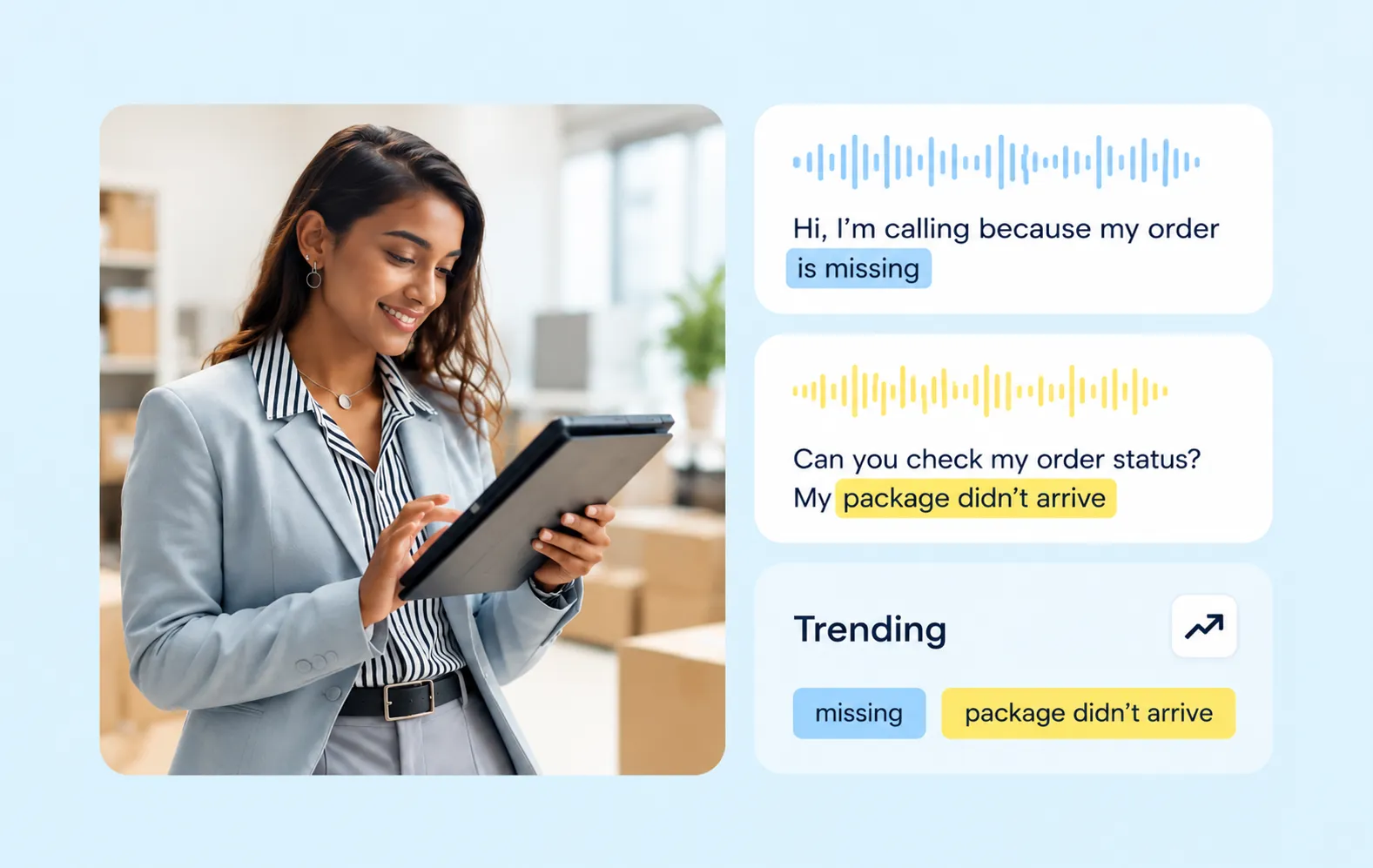
Call transcription builds a database of important key phrases for call analytics.
How does call transcription work
These best practices help you extract maximum value from your transcription solution investment to your call center.
Look for patterns across multiple calls
Individual transcripts tell stories. Hundreds of calls reveal patterns, and potentially systemic issues. Track recurring phrases, common complaints, and frequent questions to identify training gaps, product problems, or process breakdowns. When swaths of customers use the same frustrated language about your return policy, you’ve found an actionable insight. Sales teams can use these patterns to refine their pitch and handle objections better.
Pay attention to word choice and create trigger word banks
Sentiments don’t always translate cleanly to text and might miss the nuance or the frustration. Build a database of trigger words and phrases that signal customer dissatisfaction, confusion, or escalation risks. Words like “cancel,” “competitor,” “unacceptable,” or “speak to a manager” should flag calls for immediate review.
Mirror customer language to improve connections
Document the actual words your customers use to describe issues, products, and solutions. Train agents to recognize and use customer terminology alongside technical terms. This linguistic mirroring reduces miscommunication during interactions.
Establish standardized analysis processes
Create clear workflows for transcript review, including who reviews calls, which metrics to track, and how findings translate to action items. Train your team on consistent categorization methods, so everyone codes similar issues the same way. Set regular review cycles - daily for trending issues, weekly for agent coaching, monthly for product improvements and policy changes.
Maintain compliance and data security
Recording and transcription laws vary by location. Work with legal counsel to establish clear consent procedures, GDPR, retention policies, and access controls that meet requirements in every jurisdiction where you operate. This is especially critical for VoIP systems that may route calls internationally.
Protect sensitive information
Automatically redact credit card numbers, social security numbers, and other personally identifiable information from transcripts. This functionality reduces security risks and helps maintain industry compliance. Train agents to avoid saying sensitive information aloud when possible, using secure channels for data collection instead.
Balance automation with human review
While AI-powered transcription handles volume, human reviewers catch nuance and context that machines miss. Establish a sampling strategy, especially for high-stakes calls or new product launches where accurate transcription is critical. This hybrid approach ensures both efficiency and quality.
Connect insights with actions
Document how transcript insights lead to specific changes - whether that’s updating scripts, modifying products, or changing policies. Track the impact of these changes on subsequent calls.
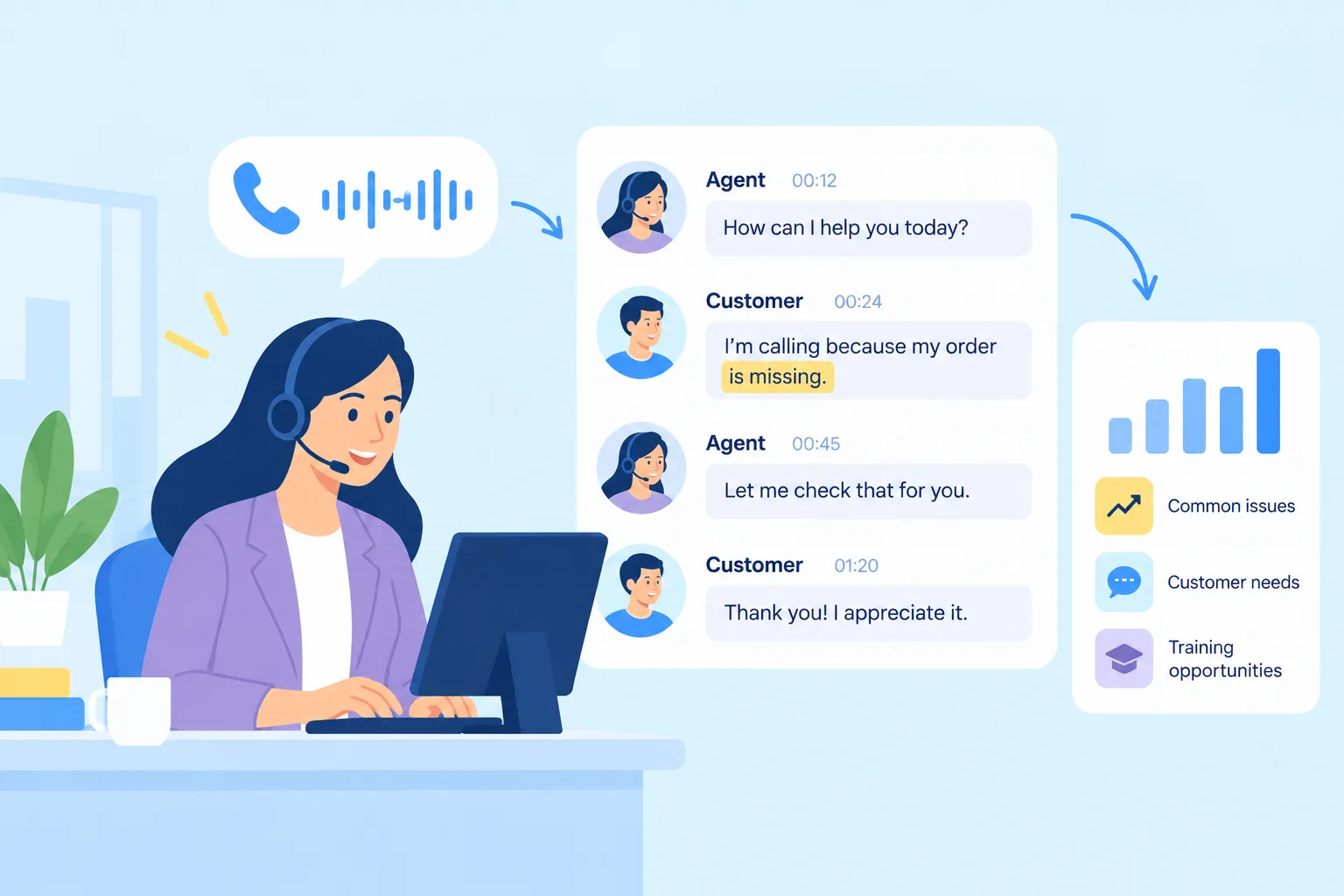
How to choose the best call transcription solution
Solutions vary widely in features, reliability, and ease of implementation. The easiest way to integrate voice transcription into your contact center is via an API. To evaluate your best API options, pay attention to features such as:
- Easy integration with call recording: Call transcription should activate with a single API parameter added to your existing recording setup. Skip vendors that require separate SDKs or complex workflows that disrupt your current processes. Look for solutions that work seamlessly with your recording system, without additional configuration.
- Extensive language support: Your customers speak different languages, so your transcription tool should, too. This capability becomes crucial for businesses serving diverse populations and markets, ensuring no customer conversation gets lost in translation. Look for tools that account for regional and industry-specific jargon and allow you to adjust localization settings to suit your customer base. Such customization significantly improves accuracy for specific markets, reducing the need for manual correction.
- Bring your own storage (BYOS): Your organization has the right to choose where your data lives – whether that’s AWS, Azure, or Google Cloud. Doing so eliminates third-party storage risk, simplifies compliance, and gives your team complete ownership of sensitive recordings and transcripts.
- Real-time transcription capabilities: For immediate intervention needs, look for options to transcribe conversations as they happen, not just after calls end. This allows supervisors to coach agents during calls and ensures critical information is captured even if recordings fail.
Real-time and post-call transcription
The right transcription solution is an important stepping stone towards smoother operations, better conflict resolution, and happier customers. Sinch Contact Pro Programmable Voice API offered by Comtrust can deliver all that, and more. It includes built-in transcription that checks all these boxes, with support for 115+ languages, locale customization, and global reliability, you can start converting conversations into good changes.
The article is based on expert materials from Sinch.
Frequently Asked Questions About Call Center Transcription
What is call center transcription?
Call center transcription converts spoken conversations between customers and agents into written text using speech-to-text technology. It helps businesses document, search, and analyze customer interactions.
How does call transcription work?
Call transcription software uses speech recognition technology to convert audio recordings into text. Some tools also provide real-time transcription, allowing conversations to be documented as they happen.
How can call transcription improve agent performance?
Managers can review transcripts to evaluate communication skills, check compliance with scripts, identify training needs, and provide targeted feedback based on real customer conversations.
How can call transcription reduce operational costs?
Transcripts help identify repetitive customer inquiries that can be handled through FAQs, chatbots, or automated phone systems, reducing call volume and allowing agents to focus on more complex issues. Agents serve customer in shorten time because they don’t need to ask all customer history.
Where are my transcripts stored?
JSON transcripts are delivered to the same destination (S3, Azure, or Google Cloud bucket) that you specify for the audio file.
Author:
Joanna Pytlakowska
VP Sales & Marketing, Comtrust
Recently added articles




Find out how customers use our products, services and SAP technology. Welcome to contact!


Products
SAP Customer Experience
SAP Field Service Management
SAP Conversational AI
SAP Intelligent Robotic Process Automation
Sinch Contact Pro
VoIP Infrastructure
1trust Service
Services
Implementations
Project management
Integration and Support
About us
Company and team
Partners and technologies
News