
Chatbots in E-commerce – how do they support customer service and sales?
Key information at a glance:
- AI chatbots for ecommerce are more than customer support tools; they can support the entire customer journey and offer 24/7 customer service. They provide immediate assistance and respond to customer inquiries around the clock.
- They help businesses increase sales and conversions by personalized product recommendations and targeted promotions encourage purchasing decisions and reduce cart abandonment.
- Chatbots simplify the shopping process by offering tailored recommendations, order tracking, and efficient problem resolution.
- Chatbots reduce operational costs automating routine customer interactions and decreases the workload of customer service teams and improves efficiency.
- Using follow-up messages, personalized offers, and reminders chatbots help maintain customer engagement and build brand loyalty.
- Effective implementation means integration the chatbot platform with CRM and Contact Center. The idea example is ready to implement 1trust packet offered by Comtrust, which creates an environment for humans and AI.
Almost anything can be bought online, so it is no surprise that many customers have shifted from traditional stores to online shopping. This trend is particularly evident in the USA, Europe, and, of course, Poland. According to Rzeczpospolita, Poles are among the most active e-commerce customers in Europe—spending an average of 2 hours per week on online shopping, compared to 1.7 hours for the average European consumer—and they make their purchasing decisions in a thoughtful manner. More than 80 percent of customers trust recommendations provided by artificial intelligence. However, nearly 6 out of 10 internet users have abandoned an online purchase because a store’s chatbot failed to resolve their issue. Experts warn that hasty and poorly executed implementations of artificial intelligence take a toll on the revenue of online retailers.
What is a chatbot in e-commerce, and how does it work?
In this guide, we talk about the benefits of e-commerce chatbots and show you use cases examples, and provide some practical tips.
Customers love the convenience of being able to get whatever they want from the comfort of their homes. At the same time, they expect the same personalized service they get in brick-and-mortar stores but paired with the speed and effortlessness of the internet. For small and large online retailers alike, these expectations can be hard to meet. While AI chatbots are key to optimizing customer service and reducing operational costs in e-commerce, poor implementation can have the opposite effect. As Rzeczpospolita points out, a flawed chatbot can easily deter potential customers
Why does your e-commerce need chatbot?
Customers expect online stores to answer their questions immediately, and at and at any time. Even with the best service team in the world, that’s very challenging (and costly!) to do.
Chatbots:
- are available 24/7
- can answer FAQs in seconds
- are knowledgeable (answer up to 80% of the most common questions successfully and always friendly and patient
- easily handle peak hours or peaks in demand
Intelligent chatbots will help you meet your customers’ demands, scale your business, all while keeping your costs low.
Chatbots are not only useful to companies, but also to customers!
- 67% of millennials say that they are more likely to shop if the website has a chatbot.
- 64% of internet users love that chatbots offer 24/7 support.
- 87% of customers find chatbots effective or very effective at resolving their issues.
- Online retail stores have the highest acceptance of chatbots by customers.
- On average, the customer satisfaction rate for chatbots is 87.58%.
So, let’s take a closer look at how you and your customers can benefit from chatbots.
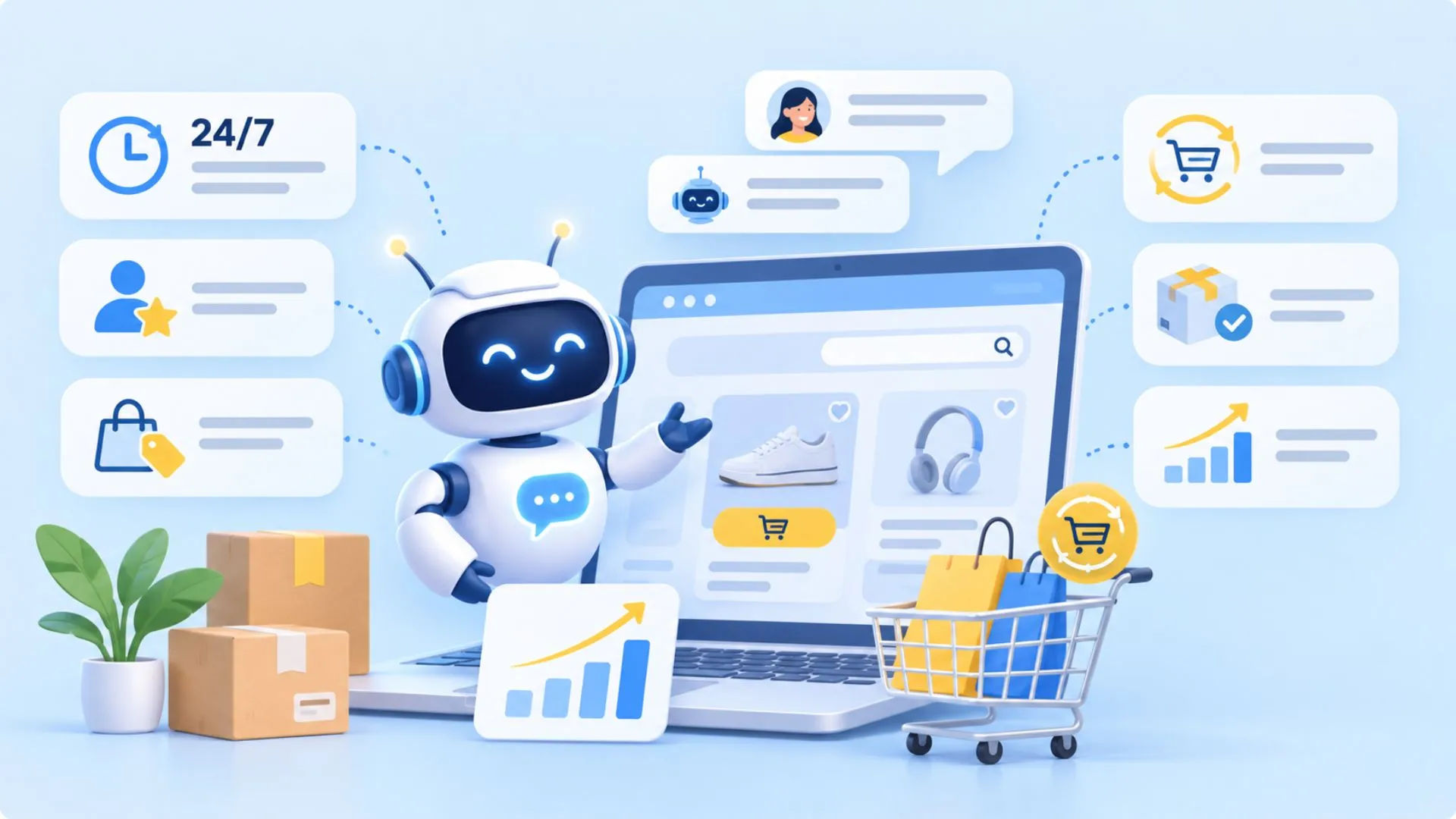
Advantages of chatbots in e-commerce
- 24/7 availability
Chatbots provide reliable assistance around the clock—without breaks, sick leave, or vacations. While it is possible to build a team of human employees with such high availability, for most companies, it is simply not financially viable.
- A more personalized customer experience
Chatbots integrated with business systems have immediate access to data, and they also collect and store a significant amount of information themselves. Consequently, they know what customers have purchased and when, allowing them to suggest restocking items. They also have access to customers’ birth dates, enabling them to offer special birthday discounts. Customers appreciate such personalized service and respond with loyalty.
- Sales chatbot – product advice and Increase sales, and cart recovery
Personalized service through chatbots will not only make your customers happier, it will also increase their spending. In a recent Statista survey, 63% of businesses said that personalization increased their conversion rates, and 31 percent of e-commerce business have noticed an increase in revenue. Customers are more likely to buy from a brand if they have a tailored experience. Proximus, a Belgian telecommunication company, for instance, saw a 20 percent increase in their web shop orders after setting up an Chatlayer chatbot.
Fewer abandoned shopping carts is add value. The online shopping process is usually not straightforward. Users might go to one shop, check out an item, put it in their shopping cart, then decide to check if they can find the same product cheaper somewhere else or compare different products. This leads to shopping cart abandonment, reaching as high as 70%. In other words, seven out of ten customers made a purchase—just not in your store. Chatbots are a great tool to reduce the number of abandoned carts. You can set them up to send reminders that have not completed their shopping process after a certain period of time, and thus cut down on abandoned carts.
- Chatbots in after-sales support – more orders, fewer returns, fewer complaints
The return rate for e-commerce companies is more than seven times as high as for brick-and-mortar stores. Chatbots can help you reduce the number of returns by
- Gathering insights on returns, and helping you fix issues faster.
- Automatically interacting with customers that want to return an item, and offer an exchange instead.
- Making the return process easier (one of the key expectations of online shoppers) and providing a good customer experience that will make shoppers come back in the future.
- Improve return on ad money spend
Online advertisements attract new customers and encourage them to make purchases in an online store. So why isn’t it working for you? Because they might not find what they were expecting from the ad or are overwhelmed with all the offers they find, so they leave. That leaves you with a terrible return on ad money you invested. The solution? Set up a chatbot to guide ad leads through the shopping process. Once customers end up on a landing page from an ad, a chatbot could welcome them, and offer help. You could even have the bot ask your customers questions or entertain them with a quiz to gather more insights and offer them tailored products. At the same time, this data will help you in the future to create more precise target groups for ads as well as more effective campaigns that will yield even better return on ad money spent.
While all your customers end up on your website, they might get there in very different ways. It may be your email newsletter, your advertisement on a smartphone, or a conversation with your call center. Your customers have different needs and preferences therefore Comtrust integrates chatbots into omnichannel communication like web chat, messaging apps, or as voicebots within telephone channels. With enterprise chatbots like Chatlayer, it is easy to deliver a consistently excellent customer experience across every channel—without straining your budget.
- Re-engage customers
If you integrate a chatbot in a messaging app, you can get even more out of the conversational commerce experience. Unlike a web chat where conversations disappear after they are closed, you can re-kindle an old conversation on a messaging app at any point. This is an ideal starting point for chatbots to send reminders for a special deal, check back in to see if a customer needs to re-stock an item, or send out marketing messages with interesting new offers.
Trigger the WOW effect
As you can see, chatbots can already be very helpful for e-commerce, but advanced bots like Chatlayer can take your business to the next level. Imagine a scenario where the interaction between bot and human feels like an actual conversation. That’s what AI chatbots can deliver. They not only understand what a human says to them, but they even grasp what that person wants, and they respond—much like a human would. That’s the power of conversational AI! Customers will notice the difference when interacting with enterprise AI bots. Meanwhile, companies achieve customer satisfaction scores of over 91%!
As AI chatbots in e-commerce have smoother interactions with customers and can understand their issues better than regular bots, AI chatbots can also solve more inquiries successfully. With the help of AI bots, companies report that they were able to double the workload and cut service costs by 30%. In addition, there are a lot more use cases for AI bots in e-commerce than for regular bots, which will increase your return on investment.
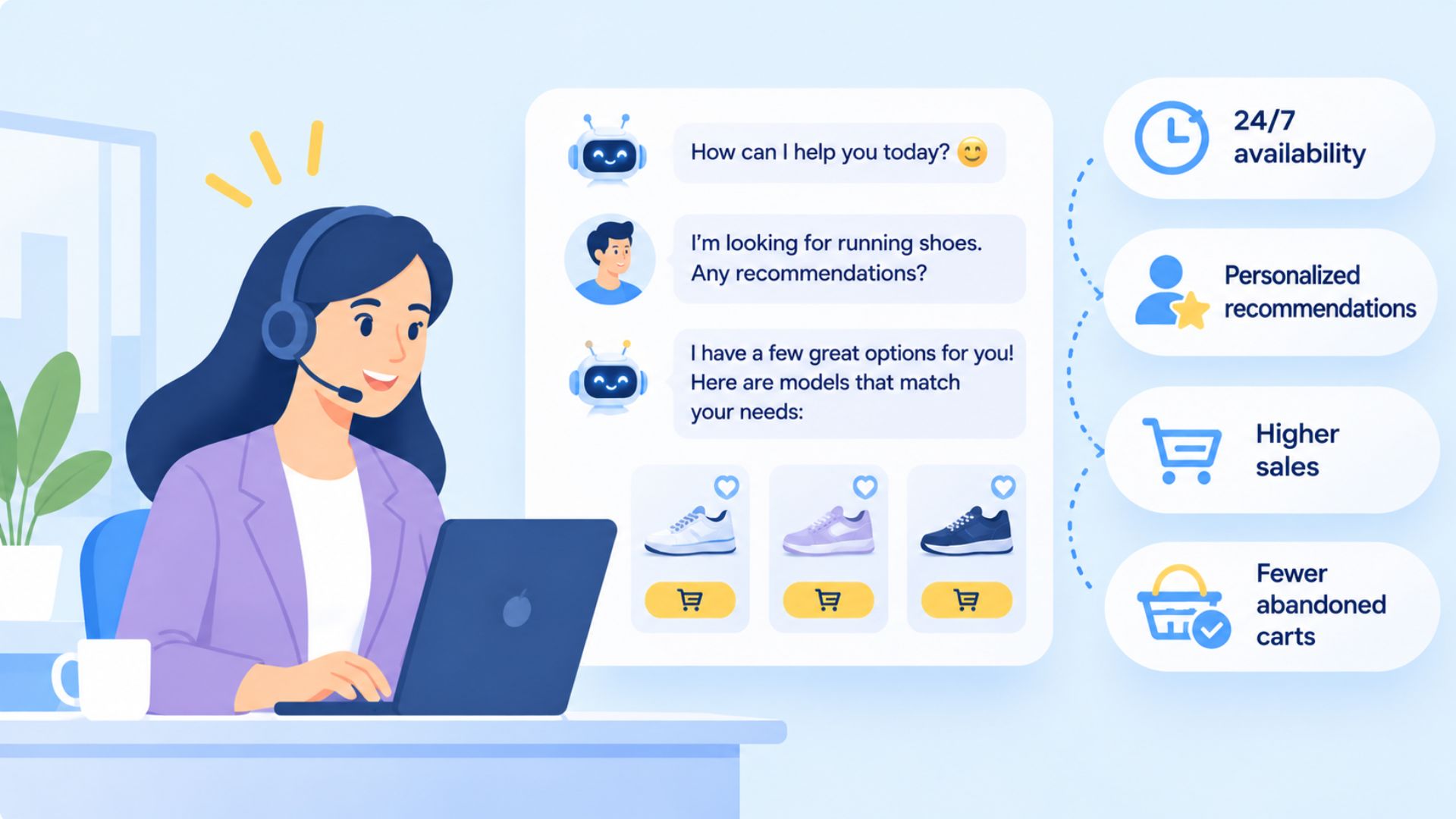
Use cases of AI chatbots in e-commerce
Most companies might think of e-commerce chatbots in terms of customer service. However, there are many more use cases for AI chatbots in e-commerce along the entire customer journey.
- Answer customer queries anytime
While brick-and-mortar stores will not always be open, and customers will understand that they have to come back during business hours, there is no such thing as a “closed” sign for online stores. In fact, a lot of users will probably browse your shop late in the evening after work, on weekends, or on holidays—because that’s when they have the time to shop. And: they expect prompt, around-the-clock, personalized service. AI-powered chatbots can offer all of that—they are capable of effectively answering frequently asked questions while providing a seamless customer experience, which can be further personalized by integrating the chatbot with a CRM or another system, such as a location-tracking tool—as is the case with a Polish logistics company.
- Lead generation
If customers are already interacting with chatbots to ask questions or order an item, why not take it one step further, and let chatbots present useful links to product pages, special deals, or coupons? Especially when using an AI chatbot, the bot will be able to understand much better what customers are looking for — and offer them the best incentive to shop.
- Guide customers through the shopping process
This is a much smoother customer experience, and it’ll boost your sales. AI chatbots can be great shopping assistants. They can pop up when needed, answer questions about products they’re looking at, advise customers on the best offers, and guide them through the entire shopping process. It’s like having that great assistant in the store that makes sure that you leave with the best product. Those are the stores we go back to, so why not use chatbots to offer the same hands-on customer experience online?!
- Upselling
Once customers interact with chatbots as shopping assistants, your bots will be able to find out what they’re really looking for. This doesn’t only allow for a more tailored experience; it also makes it easier to upsell. Let’s say a customer wants to get a new cover for their smartphone, but the bot knows that your shop is currently offering a special discount for headphones. The bot tells the customer about the deal, and the customer realizes that she actually also needs new headphones and gets them as well. In the end, the customer had a better shopping experience, saved money, and you improved your revenue.
- Help track delivery status
Once customers ordered something online, they can’t wait to receive the package. So, instead of them having to go online and typing in an order number, you can set up a chatbot that can inform them about the delivery status much faster. It’ll save your clients time and improve their customer experience.
- Schedule consultations or service appointments
Depending on what you sell, there might be a need to schedule consultations before buying a product or maintenance appointments post-purchase. This is also a process that can be easily automated with chatbots.
- Act as brand ambassador
Against popular belief, chatbots can be very appealing to customers. Aquanet has created a bot named Basia, which assists customers and helps boost brand awareness!
Chatbot integrations with business and ordering system, CRM, and Contact Center
If you want to effectively manage customer service and sales processes across all communication channels—with the support of artificial intelligence—integrating your chatbot with your CRM and Contact Center is essential. Comtrust has integrated SAP business systems with communication tools and AI from Sinch, offering companies a ready-to-deploy package called 1trust.
With 1trust, you can provide your customers with an experience that exceeds their expectations – at every touchpoint and across every communication channel. If you want to expand your business, you need to offer perfect next-gen service and ensure excellent CX. Your customer service should be intelligent and equipped with AI features for smooth managing of repeating tasks, and give your support team the right tools to resolve all customers issues promptly in a shorter time. Very often new sales opportunities arise in customer care departments what directly affects to the entire company’s sales results. With the 1trust package organizations are able to cover every touchpoint in a customer service engagement and exceed customer expectations every time and sell more. Simple inquiries are manage by AI chatbot (Sinch Chatlayer), more complex inquiries are solved by humans. Service and sales teams work on SAP CX where all data is stored and they deliver consistent, contextual and relevant experiences. Additionally, SSAP CRM offers rich 360° customer view, advanced ticketing solution, sales lead management and lot of innovative tools, such as AI services. Companies can bring a consistent, unified service and sales experience for customers across all channels. Contact Center solution is embedded in CRM as a widget. Customers can seamlessly switch channels and service agents can respond on any channel within the context of previous conversations. Sales teams have a unified view of all your customer data across all touchpoints including interactions across various channels, past product purchases, open customer service tickets etc. 1trust crafts the ultimate experience for both – your customers and your employees, as well as increases customer loyalty.
How to get started with e-commerce chatbots, step by step?
Start with one use case. Because chatbots have so many use cases in e-commerce, it is best to implement them in stages rather than automating everything at once. You can identify the most important use case and begin there. This allows you to test and improve the solution, making it easier to scale later on. For the best results, clearly define your goals and set a roadmap outlining exactly what the chatbot should—and should not—do. This will help set clear expectations and ensure the best possible outcome.
FAQ
How much does a chatbot for ecommerce cost?
In the case of the chatbot offered by Comtrust, you a subscription agreement, gaining access to certain features and a number of conversations included with your subscription. Each plan is based on the amount of conversations that the bot has with users per month. Depending on the chosen plan the monthly cost for an Enterprise-level bot is several hundred EUR.
Can a chatbot handle returns and complaints?
Yes, Chatlayer offered by Comtrust can handle returns and complaints, though how much it resolves on its own depends on how deeply you connect it to your order systems and where you set human escalation rules.
Will a chatbot replace consultants in an online store?
No—a chatbot will not fully replace human consultants in an online store, though it will replace a large portion of their repetitive, routine tasks. In practice, successful online stores use a hybrid model: the chatbot handles high-volume, predictable interactions 24/7, while human consultants focus on complex, emotional, or high-value sales situations.
How long does it take to implement a chatbot in e-commerce?
Implementing an e-commerce chatbot takes anywhere from a few hours to 3+ months, depending on how deeply you connect it to your store’s business systems and whether you build custom workflows.
Author:
Joanna Pytlakowska
VP Sales & Marketing, Comtrust




Find out how customers use our products, services and SAP technology. Welcome to contact!


Products
SAP Customer Experience
SAP Field Service Management
SAP Conversational AI
SAP Intelligent Robotic Process Automation
Sinch Contact Pro
VoIP Infrastructure
1trust Service
Services
Implementations
Project management
Integration and Support
About us
Company and team
Partners and technologies
News